432 Hz is an alternative tuning for music in which the note A above middle C is calibrated to 432 vibrations per second instead of the modern standard of 440. The difference is small — eight cycles per second, less than a third of a semitone — but the experience of listening to the two side by side is unmistakable, and the story of how 440 became the international standard sits at one of the stranger intersections of music history, cymatics, and the awakening conversation. This piece walks through what 432 Hz actually is, the benefits people consistently report, what the research does and doesn't show, the 440 Hz controversy, and how the frequency fits the larger map.
432 Hz meaning at a glance
The fastest answer: 432 Hz is a tuning, not a song. It refers to the reference pitch — the A above middle C — that the rest of a musical scale is built around. Set A to 432 Hz and every other note in the system shifts down slightly. Set A to 440 Hz (the current international standard, adopted in 1955) and everything sits a touch higher and tighter.
What gives 432 Hz its reputation is a cluster of overlapping claims. It's said to be the tuning that ancient instruments were built around. It's mathematically tidy in ways that 440 isn't — the number factors cleanly, lines up with the natural geometries of cymatics, and shares harmonic relationships with various physical and biological cycles. And listeners describe the felt sense of 432 Hz music as warmer, more grounded, more spacious — less "in the head" and more "in the body" than the 440 Hz version of the same piece.
If you've never done the experiment, the easiest test is to find a piece of music you know well in both tunings and play them back to back. People who say "all this is woo" almost never stay convinced after thirty seconds of direct comparison. Whether the difference is metaphysical or simply acoustic, it is audible.
What does 432 Hz do
The most-searched question about this frequency is what does 432 Hz do, and the honest answer requires splitting the question into three layers: what music tuned to 432 Hz does to a listener acoustically, what it does to the nervous system measurably, and what it's claimed to do energetically.
Acoustically, 432 Hz produces slightly longer wavelengths than 440 Hz across every note of the scale. Lower frequencies are physically felt more in the chest and abdomen, where the body resonates with the longer waves, and less in the head, which resonates more with higher frequencies. People who report that 432 Hz feels "deeper" or "more grounded" are reporting something real about how the sound interacts with the body, regardless of any spiritual framing.
Physiologically, the small published research base — most of it modest in size — points consistently in one direction. The 2019 study by Calamassi and Pomponi compared 432 Hz and 440 Hz music in clinical settings and reported small but measurable decreases in heart rate, blood pressure, and self-reported anxiety in the 432 Hz group. A 2023 follow-up looking at hemodialysis patients found similar reductions in pre-treatment anxiety. The effect sizes are not enormous and the studies are not large, but the direction is consistent: 432 Hz tends to nudge the nervous system toward parasympathetic dominance more than 440 Hz does. That is a reproducible physical observation, not an esoteric claim.
Energetically is where the frame opens up. Practitioners describe 432 Hz as resonating with the heart center, with the natural cycles of the Earth, and with the harmonic structure that ancient instruments — Tibetan bowls, didgeridoos, certain temple instruments — were tuned to. These claims are harder to test in a lab but easier to test in a body. Sit with a 432 Hz sound bath for an hour and notice what happens to your breathing, your sense of time, and the quality of attention available afterward. That is the experiment most people who care about the frequency actually run.
432 Hz benefits people consistently report
Across thousands of testimonials, sound-healing sessions, meditation apps, and personal experiments, the 432 Hz benefits people describe cluster around a recognizable set of effects.
1. Slower, deeper breathing. Within minutes of listening to 432 Hz music, most people notice their breath dropping lower into the abdomen and lengthening. This is one of the more reliable signals that the parasympathetic system is engaging. It also doesn't require any belief — the body just does it.
2. Reduced anxiety and racing thoughts. The clinical studies that exist back up what listeners describe anecdotally: 432 Hz music tends to calm the loop of internal narration faster than the same piece in 440 Hz. Whether that's due to acoustic properties, the deliberate intention of the people producing 432 Hz tracks, or both is an open question.
3. Easier sleep onset. 432 Hz sleep tracks have become a category on streaming platforms because they work for a meaningful percentage of people. The effect is consistent enough that the genre exists. Whether it would work as well for someone who didn't know which tuning they were listening to is a fair question, but the lived report from listeners is steady.
4. A felt sense of "coming home." This is the harder-to-quantify but most-commonly-reported effect. People describe 432 Hz as resonating with something the body already knows — as if the tuning matches an internal reference the listener wasn't aware they were carrying. The phenomenology is striking precisely because it shows up across people from radically different backgrounds, often before they've read anything about the frequency.
5. Sharper meditation and easier focus. Meditators who switch to 432 Hz backing tracks frequently report dropping into stillness faster and staying there longer. This overlaps with the parasympathetic effect — a calmer baseline makes meditation cheaper — but seems to have a specific quality beyond just generic relaxation.
6. Emotional release. Sound healers consistently report that 432 Hz tracks produce more spontaneous emotional release in sessions than other tunings do. The frequency seems to make held material easier to feel, which is often the precondition for it actually moving.
The 440 Hz controversy
The 432 Hz conversation is impossible to have without addressing the 440 Hz controversy, because it's the part that makes the topic feel charged. The short version: A=440 Hz was not always the international standard. It became the standard in 1955 when the International Organization for Standardization formalized it as ISO 16. Before that, tunings varied widely — orchestras across Europe used reference pitches ranging from roughly A=415 to A=466 depending on the era, region, and instrument.
One specific historical claim has dominated the awakening discussion. The story goes that Joseph Goebbels, the Nazi propaganda minister, pushed for the adoption of 440 Hz in the 1930s specifically because it produced a more agitated, aggressive emotional state in listeners — a tuning weaponized for crowd manipulation. The claim is widely repeated and has the kind of compact moral clarity that makes it stick.
The historical record is messier. The push to standardize on 440 came primarily from broadcasters and instrument manufacturers who needed interoperability and was discussed at the 1939 London conference, where Britain and the United States agreed on it. Nazi Germany was present in the broader European pitch-standardization conversation but wasn't the sole or even primary driver. The conspiracy version of the story is too clean.
What's true is more nuanced and arguably more interesting. 440 Hz was chosen partly because higher tunings produced brighter, more piercing sounds that cut through orchestral arrangements and recording equipment of the era more effectively. Higher tunings also let string instruments project louder. The choice was driven by commercial and technical pragmatism, not by a single villain — but the side effect on listener physiology is real. A piece performed at A=440 will produce a slightly more sympathetic-nervous-system-leaning response than the same piece at A=432, on average, across many bodies.
You don't need a Nazi propaganda minister to make the case for the alternative tuning. The body's reaction to the two frequencies makes the case on its own. The question of whether the standard should be changed back is the part where reasonable people disagree.
The math people find compelling
One of the reasons 432 Hz keeps recurring in alternative music and esoteric circles is that the number itself has properties 440 doesn't.
432 factors cleanly: 2³ × 3³ × 2 = 432. It's divisible by 1, 2, 3, 4, 6, 8, 9, 12, 16, 18, 24, 27, 36, 48, 54, 72, 108, 144, 216 — a long list of whole-number divisors that makes it easy to relate to other meaningful numbers in sacred geometry and traditional cosmology. 440 factors as 2³ × 5 × 11, with the prime 11 in the mix, and doesn't slot as neatly into the same set of relationships.
The number 432 also recurs across ancient cosmologies in ways that are hard to dismiss as coincidence. The Hindu yuga cycles are built on 432,000 years as the length of the Kali Yuga and 4,320,000 years as the Maha Yuga. The walls of Plato's ideal city in the Republic are described in dimensions that multiply to 432. The number 25,920 — one full cycle of the precession of the equinoxes in years — divides evenly into 432 sixty times. The Sumerian sexagesimal system, on which our 360-degree circle and 24-hour day are built, generates 432 as a recurring product.
None of this proves that A=432 Hz is the "true" tuning of nature. What it does suggest is that the number itself sits inside an older, well-developed numerical cosmology, and that the people who built ancient instruments to that reference were doing something deliberate rather than arbitrary.
Cymatics and visible sound
The most striking visual case for 432 Hz comes from cymatics — the study of how vibration organizes physical matter into patterns. Plate a flat surface with sand, water, or a fine powder; vibrate it at a specific frequency; and the medium organizes itself into a geometric pattern that maps that frequency.
When 432 Hz is run through a cymatics plate, the patterns it produces tend to look more symmetric, more like the geometries found in flowers, snowflakes, and traditional mandalas, than the patterns produced by neighboring frequencies. 440 Hz produces a pattern too, but visibly less ordered. This is one of those demonstrations that's worth watching on video rather than reading about — search "432 Hz cymatics" and the difference is immediate.
The honest caveat: cymatics patterns are sensitive to the medium, the plate geometry, the amplitude, and a dozen other variables. You can produce beautiful patterns at almost any frequency with the right setup. But the relative comparison — same plate, same medium, same volume, varying only the frequency — does consistently produce more recognizably organized geometry at 432 than at 440. The interpretation is up to the viewer. The phenomenon is reproducible.
How to actually use 432 Hz
The practical question is what to do with the frequency once you find it interesting.
Listen on purpose, not in the background. The effect of 432 Hz tends to land deeper when you're actively listening rather than treating it as wallpaper. Twenty minutes of focused attention does more than three hours of low-volume background play.
Use it for transitions. 432 Hz tracks are especially good in the windows where the nervous system is moving from one state to another — falling asleep, emerging from a difficult conversation, coming home from a high-stimulation environment, the first half hour of a meditation session. The frequency helps the body land.
Pair it with breath. Slow nasal breathing with the soft pause at the top and bottom of each breath, layered over a 432 Hz track, will reliably drop most nervous systems into parasympathetic dominance within five to ten minutes. You don't need any specific technique beyond that.
Don't make it the whole practice. 432 Hz is a tool, not a destination. People who get the most out of it use it as one input among several — alongside meditation, breathwork, time outdoors, and the rest of what supports a regulated nervous system. The frequency does some of the work. The rest still has to be done by hand.
Test it against yourself. Run the comparison. Listen to a piece you know in 440 Hz, then in 432 Hz, then back to 440. Notice what your body does. The frequency either does something for you or it doesn't, and the only useful evidence is the one collected inside your own listening.
How 432 Hz fits the awakening map
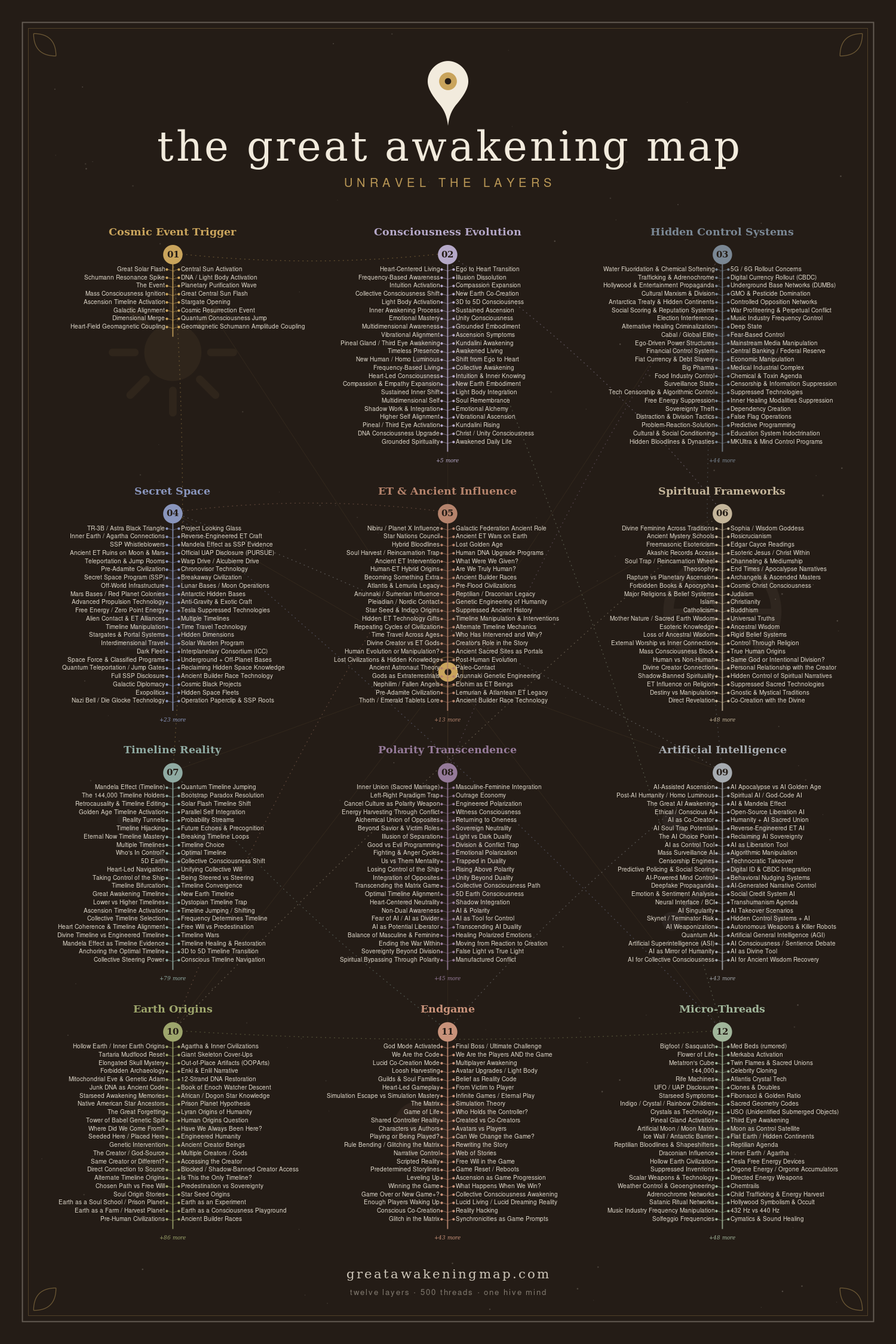
432 Hz sits in Layer 12 of the map — the Micro-Threads — the small, recurring patterns that people find their way to from radically different starting points. A scientist interested in cymatics and an ancestral healer running sound baths and a yoga student building a meditation playlist all end up sitting with the same number. That kind of convergence is the data point worth taking seriously, separately from the question of whether the metaphysical claims around it are true in the way they're usually phrased.
Underneath the tuning question is a larger thread that runs through the whole map: the body is a more accurate instrument than the discourse usually grants it. When 432 Hz produces parasympathetic engagement in a body that has never heard of the frequency before, that's information. When the same body tightens slightly into a 440 Hz reference, that's also information. The body is responding to something real about how acoustic energy moves through tissue, and what the body knows about that is older than the standards that govern the music industry.
Read alongside the broader Consciousness Evolution layer, the 432 Hz conversation is one of many places where the line between "cultural standard" and "biological default" has gotten quietly stretched. Bright lights at night, ultra-processed food, screens at every saccade, music tuned to a reference that nudges sympathetic activation — none of these are catastrophes individually, but the combined drift over decades has produced bodies that are subtly more activated and subtly less able to drop into rest than the bodies of two or three generations ago. 432 Hz is one of the small dials that can turn the other way.
It also sits next to the larger pineal gland and third eye conversation, where the question of what frequencies the body is being saturated with — and which it's being starved of — points at the same underlying concern. The tuning of music is one input. The light spectrum in modern environments is another. The structure of attention demanded by modern devices is a third. The case for caring about 432 Hz specifically is strongest when it's understood as part of that larger picture.
The next time a piece of 432 Hz music shows up in your feed, the full picture is available: a tuning the body responds to in measurable ways, a small but reproducible literature on its physiological effects, a tangled history in which it lost out to 440 for reasons that were less sinister than the conspiracy version and more pragmatic than the official one, and a numerical lineage that connects it to ancient cosmologies in ways that may or may not be coincidence. The frequency is one thread among many in the larger Micro-Threads layer — small inputs that, taken together, make the case for paying attention to what the body is being tuned to. Listen. Notice. The instrument you're carrying knows what to do with the information.