Göbekli Tepe is the most consequential archaeological discovery of the last hundred years, and most people have still never heard of it. A complex of T-shaped megalithic pillars carved with animals, raised on a Turkish hilltop around 9500 BCE — six thousand years before Stonehenge, seven thousand before the pyramids, and several thousand before the supposed invention of agriculture, the wheel, or writing. The standard story of human civilization says this site cannot exist. It exists anyway. And in 8000 BCE its builders deliberately buried the entire thing, which is its own separate mystery.
Where is Göbekli Tepe
Göbekli Tepe sits on a limestone ridge in southeastern Turkey, about ten miles northeast of the city of Şanlıurfa, in the historical region known as Upper Mesopotamia or northern Anatolia. The name translates roughly as "potbelly hill" — a reference to the rounded mound that hid the site for millennia. From the top of the ridge you can see across the Harran plain, with the Taurus Mountains rising to the north. It is dry, windswept country now, but during the late Pleistocene this region was greener, with rivers and woodland, sitting at the heart of what archaeologists call the Fertile Crescent — the band of land where wheat, barley, and several other staple crops were first domesticated. This geography matters. Göbekli Tepe was built right at the seam where the human story is supposed to have turned from wandering to settling. It turned out to be the place that broke the seam open.
The site was first noticed by an American-Turkish survey team in 1963 but written off as a medieval cemetery. The real excavation only began in 1994, when the German archaeologist Klaus Schmidt arrived from the German Archaeological Institute, took one look at the T-shaped pillar fragments lying on the surface, and understood what he was standing on. Schmidt directed excavations there until his death in 2014. The work continues. After more than thirty years of digging, ground-penetrating radar suggests less than ten percent of the site has been excavated. Most of Göbekli Tepe is still in the ground.
How old is Göbekli Tepe, and when was it built
Radiocarbon dating of organic material from the fill places the oldest layers of Göbekli Tepe at roughly 9500 BCE, with construction and use continuing through about 8000 BCE. That makes the site between 11,500 and 12,000 years old. To get a feel for what that number means: the Great Pyramid of Giza was built around 2560 BCE, so Göbekli Tepe is older than Giza by the same span of time that separates us from the founding of the Roman Empire. Stonehenge began around 3000 BCE. The earliest cities of Sumer rose around 4500 BCE. Writing was invented around 3200 BCE. Göbekli Tepe predates every single one of these by thousands of years.
The dates come from two periods archaeologists call the Pre-Pottery Neolithic A (roughly 9500–8700 BCE) and the Pre-Pottery Neolithic B (8700–7000 BCE). "Pre-Pottery" means exactly what it sounds like: these people had not yet invented ceramic vessels. They had no metal. They had no writing. They had no wheel. They almost certainly had no draft animals, since the domestication of cattle and sheep was still in its earliest phases in this region. What they did have was the technical and organizational capacity to quarry, transport, shape, raise, and carve forty-ton blocks of limestone into ringed enclosures aligned with the heavens. Archaeology textbooks written before 1994 said this combination of capabilities was impossible. The textbooks were wrong.
The Göbekli Tepe civilization: who actually built it
This is the part that quietly rearranges the entire human story. The builders of Göbekli Tepe were not farmers. They were hunter-gatherers. There is no evidence of domesticated grain at the site, no settled village underneath it, no granaries, no permanent houses, no fields. The bones found in the fill are from wild gazelle, wild aurochs, wild boar, wild birds. These people were following herds and gathering plants — the supposed final stage of the long pre-civilized human existence — and yet they were also building the largest stone monuments anyone on Earth had built up to that point.
The mainstream model of how civilization began, taught in every introductory anthropology course for the last century, says it went like this: humans figured out agriculture, agriculture produced food surplus, food surplus allowed permanent settlement, permanent settlement allowed specialization of labor, specialization allowed monumental construction and organized religion. Agriculture first. Temples last. Göbekli Tepe inverts the entire sequence. The temple comes before the village. The ceremonial architecture comes before the granary. Klaus Schmidt's reading of this — and many archaeologists now agree with him in some form — is that shared ritual and symbolic life may have been what pulled scattered hunter-gatherer bands into the kind of cooperation and seasonal aggregation that eventually produced agriculture. Religion, in other words, may have invented civilization, not the other way around.
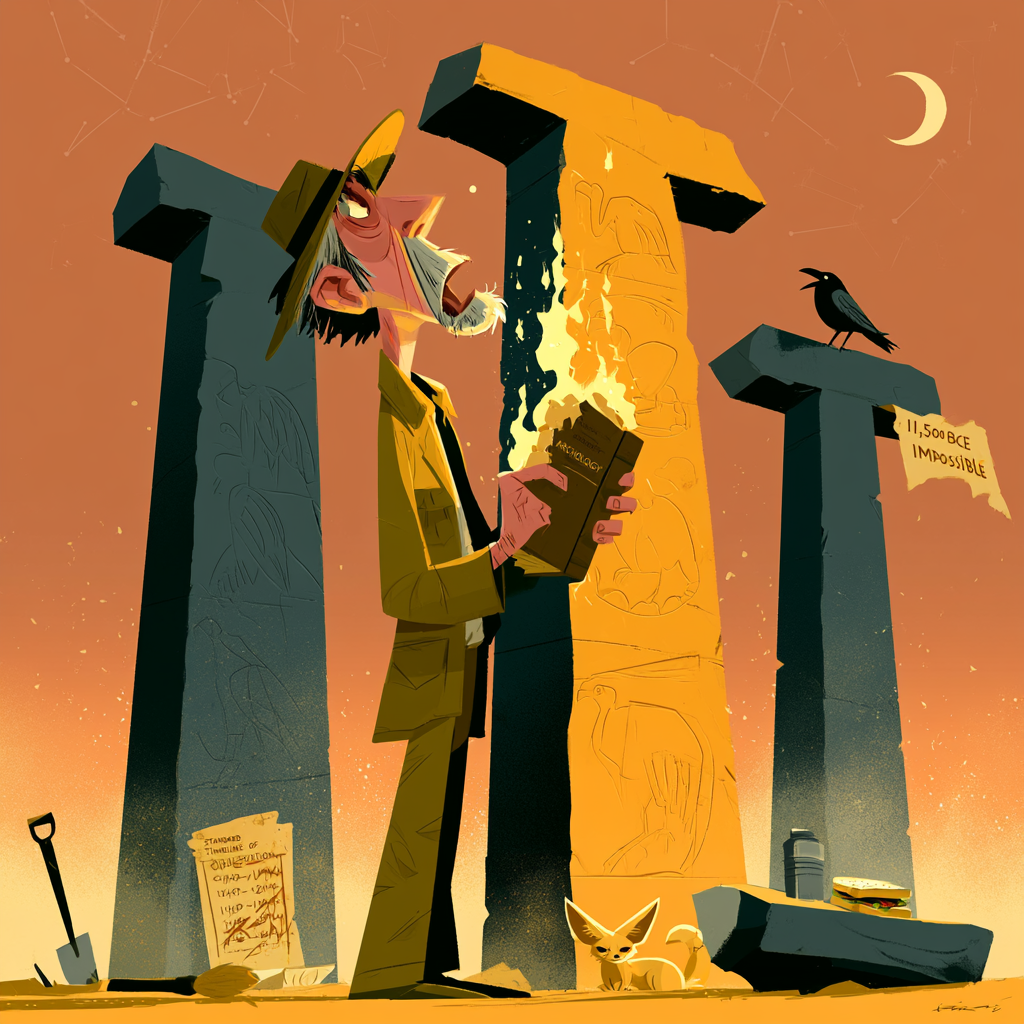
The pillars themselves are the central artifact. Each enclosure consists of a ring of T-shaped limestone monoliths, with two larger central pillars flanked by smaller ones embedded in stone walls. The largest pillars stand around six meters tall and weigh between ten and twenty tons. They were quarried from limestone outcrops several hundred meters away and dragged up the ridge — by people with no metal tools, no wheels, and no draft animals. The T-shape is now widely interpreted as a stylized human form: the horizontal top is the head, the vertical shaft the body, and on several of the central pillars you can see arms and hands carved in low relief on the sides, with belts and loincloths at the waist. These are not abstract decorations. They are figures. The two central pillars in each enclosure may represent ancestors, deities, or twin guardian beings — we don't know yet, and we may never know.
Carved into the sides and tops of the pillars is a menagerie that would be at home in a shaman's nightmare: foxes, scorpions, snakes, vultures, lions, wild boars, aurochs, cranes, spiders. Some are rendered in flat relief, some sculpted in three dimensions, some shown in motion. Vultures and snakes are particularly common. There is almost no plant imagery and very few human figures. The animals dominate. Whoever these people were, they thought about the world through the bodies of dangerous creatures.
Göbekli Tepe theories: what was it for
Nobody knows what Göbekli Tepe was for. That is not a rhetorical flourish — it is a literal statement of where the evidence stands. There are several serious theories, each with real arguments behind it. The honest position is that more than one of them might be partly right.
The ceremonial-center theory. This is Klaus Schmidt's original interpretation and remains the mainstream view. Göbekli Tepe was not a village. It was a pilgrimage site — a place where hunter-gatherer bands from a wide region converged at seasonal intervals to perform ritual, hold feasts, bury the dead, and renew social bonds. Vast quantities of animal bones in the fill suggest feasting on an unusual scale. The lack of domestic structures suggests nobody lived there permanently. Schmidt called it "the world's first temple," and the phrase stuck.
The astronomical-alignment theory. Several researchers have argued that the central pillars of certain enclosures align with the rising of specific stars — Sirius, Deneb, and others — at the time of construction. The most contested example is Pillar 43, the so-called Vulture Stone in Enclosure D. In 2017 Martin Sweatman and Dimitrios Tsikritsis published an analysis arguing that the symbols on Pillar 43 encode a date — specifically, a memorial of the Younger Dryas comet impact around 10,800 BCE, an event that may have triggered the sudden climate shift at the end of the last Ice Age. Most archaeologists reject this reading as overinterpretation. But the question of whether at least some of the carvings encode astronomical or calendrical knowledge remains genuinely open, and several alignment studies have been peer-reviewed.
The lost-civilization theory. Outside mainstream archaeology, Göbekli Tepe has become exhibit A for the argument that there was a sophisticated culture on Earth before the end of the Ice Age — a culture wiped out or driven into hiding by the cataclysms of the Younger Dryas, surviving only as scattered teachers among the hunter-gatherer remnants. Graham Hancock has built much of his career around this thesis, and Göbekli Tepe is the strongest piece of evidence he points to, because the technical sophistication of the site really does seem to arrive fully formed, without the long developmental sequence you would expect. The mainstream rebuttal is that we simply haven't found the earlier sites yet, and that hunter-gatherer cultures were probably more capable than we gave them credit for. Both can be true at once.
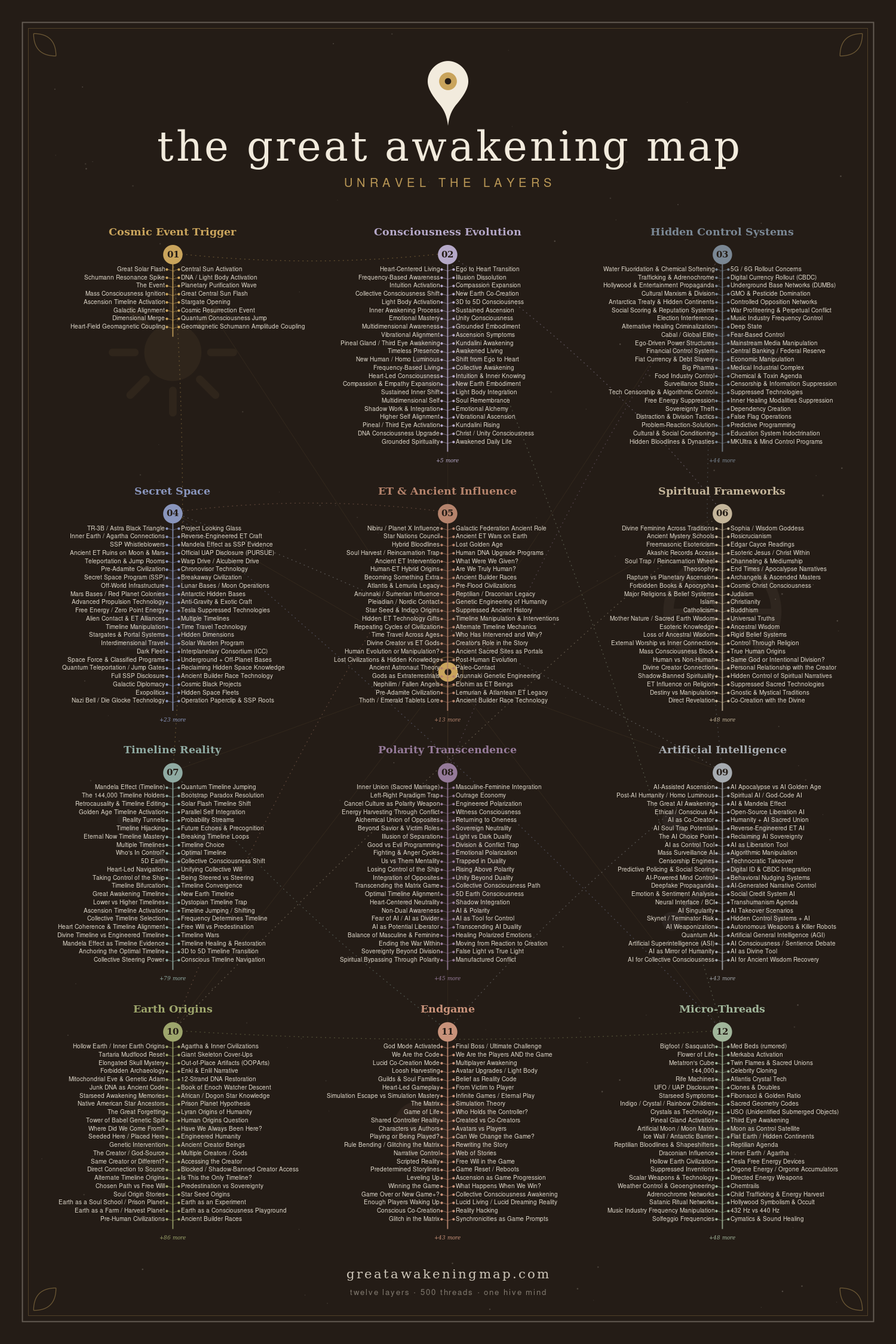
The Great Awakening Map's Suppressed Ancient History thread holds this question without forcing it closed. Whatever you think of Hancock's specific claims, the broader observation stands: human prehistory is far stranger and far older than the version most of us were taught, and the standard chronology is being revised in real time by sites like this one.
The deliberate burial: a mystery inside the mystery
Around 8000 BCE — after roughly fifteen hundred years of use — the people of Göbekli Tepe did something nobody fully understands. They deliberately backfilled the entire site. Every enclosure was packed with earth, broken bone, flint debris, and stone fragments until the pillars were completely buried. This was not erosion or collapse. It was an organized, intentional act of interment, almost certainly performed as a ritual of closure. The fill is what preserved the site so well — sealed and protected for ten thousand years until Schmidt's team began to dig.
Why bury something so carefully built? There is no consensus answer. Possibilities include: the site was decommissioned because its purpose had been fulfilled or its sacred power exhausted; the cultural group that built it was being displaced and chose to hide rather than abandon the temple; the burial was itself the final ceremony, a way of returning the structures to the earth in a deliberate parallel to human burial. None of these explanations is fully satisfying. The act of burying it is, in some ways, as remarkable as the act of building it.
Karahan Tepe and the wider Taş Tepeler
Göbekli Tepe is no longer alone. Since the late 2010s, Turkish archaeologists have identified at least a dozen contemporaneous sites across the same region, collectively known as the Taş Tepeler — "the stone hills." Karahan Tepe, about thirty-five kilometers away, is the most spectacular of these. Excavations there have uncovered carved heads emerging from rock walls, phallic pillars cut from bedrock, and an enclosure that may be even older than Göbekli Tepe. What is now clear is that we are not looking at a single anomalous site. We are looking at an entire culture — one that built monumental architecture, encoded symbolic knowledge in stone, and operated across a large region of southeastern Anatolia at the close of the last Ice Age. UNESCO recognized Göbekli Tepe as a World Heritage Site in 2018. The Taş Tepeler complex as a whole is still being mapped.
Why it matters in the awakening map
Göbekli Tepe matters because it is a hard piece of evidence — quarried, carved, dated, peer-reviewed — that the official story of human origins is incomplete. Twelve thousand years ago, somebody knew how to build this. We do not know who they were, where their knowledge came from, what they believed, or why they buried it. The mainstream answer is that hunter-gatherers were simply more capable than anthropology assumed. The alternative answers run from a lost terrestrial civilization to inherited knowledge from earlier teachers, including the non-human variety. The Great Awakening Map's ET & Ancient Influence layer is the framework for holding all of these possibilities at once without collapsing into any single one prematurely.
If you find the Anunnaki strand of ancient-origins theory compelling, the Anunnaki Genetic Engineering thread and our companion post on the Anunnaki genetic engineering theory work through Sitchin's reading of the Sumerian tablets and the parallel claims of intervention in human development. Göbekli Tepe sits chronologically just before the period those texts describe, which is part of why it matters: it is the missing context that Sumer itself never explained.
Göbekli Tepe is the kind of discovery that should have rewritten every textbook the moment Schmidt understood what he was looking at. It hasn't, yet, because the implications are too uncomfortable for the institutions that have to absorb them. But the site is real. The dates are real. The pillars are still standing where their builders raised them twelve thousand years ago, and they are still asking the same question: who were you, and how did you know what you knew. The ET & Ancient Influence layer of the map is built around questions like this one — held openly, examined seriously, and refused easy answers.