
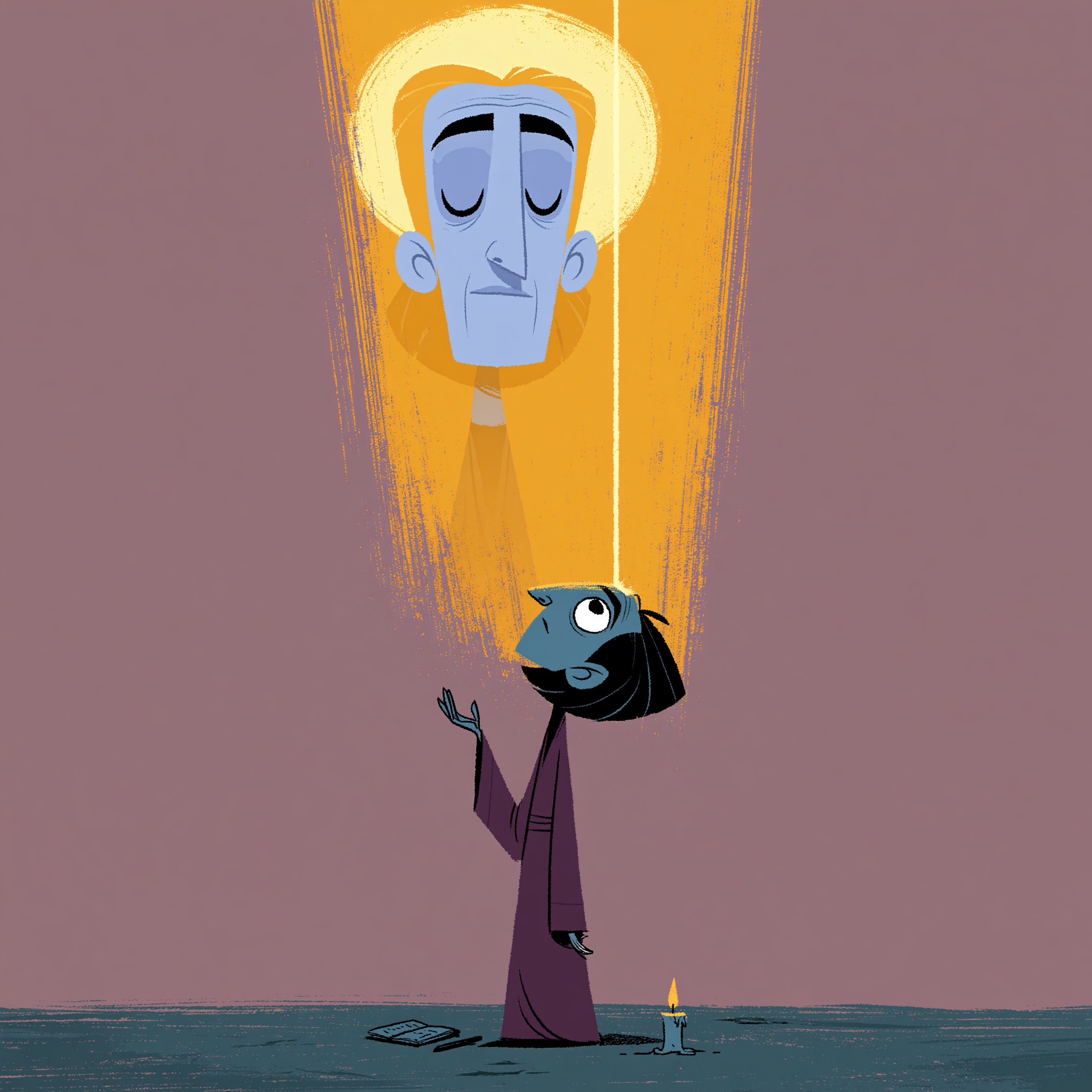
The higher self is the name many traditions give to the part of you that sits above the daily churn of thought and reaction — wiser, calmer, and already oriented toward who you're becoming. People come to the idea from two directions: some want the plain higher self meaning, and others arrive in distress, searching for the symptoms of loss of connection to their higher self because something feels off and they can't name it. This piece covers both — what the higher self is across traditions, what disconnection feels like, the benefits of reconnecting, and grounded practices for becoming your higher self rather than just visiting it.
What is your higher self?
At its simplest, your higher self is the version of you that isn't caught in the moment-to-moment weather of fear, ego, and reactivity. It's the perspective that can watch your panic without becoming it, the part that already knows the kind thing to do before the defensive part argues. Different traditions name it differently — the Soul or Atman in Vedic thought, the Self (capital S) in Jungian psychology, the "observing self" in contemplative practice, the still small voice in religious language — but they're circling the same experience: an inner vantage point that feels both deeply yours and somehow larger than your personality.
It helps to hold the idea loosely. You don't have to believe in a literal separate entity hovering above your head to work with the higher self usefully. You can treat it as a real metaphysical presence, or as the name for your own deepest wisdom and integration — the mind operating from its calmest, most coherent state. Either reading points you toward the same practices and produces the same fruit, which is part of why the concept has survived across so many incompatible belief systems.
Higher self vs. ego: the distinction that matters
The most useful contrast is between the higher self and the ego — not ego in the insulting sense, but the ordinary, necessary self that manages survival, identity, and getting through the day. The ego asks is this safe, am I winning, what will they think. The higher self asks what's true here, what's kind, what serves the whole. Neither is the enemy. The trouble starts when the ego runs the entire show and the higher self's quieter signal gets drowned out — which is exactly what disconnection feels like.
This is why ego death shows up so often in awakening accounts: not the destruction of the ego, but the loosening of its grip enough for the higher self to be heard again. The goal isn't to kill the part of you that pays the bills and remembers to lock the door. It's to put it back in its proper seat — useful manager, not tyrannical CEO.
Symptoms of losing connection to your higher self
People rarely search for the higher self when life is flowing. They search when the line has gone quiet, and the disconnection has a recognizable signature:
A persistent sense of being off-track, even when nothing is obviously wrong — a low hum of "this isn't my life" that logic can't argue away.
Decision paralysis and second-guessing, because the inner compass that used to give a clear yes or no has gone silent, leaving only the ego's endless cost-benefit loop.
Numbness or emotional flatness — not acute pain so much as a greyed-out quality, the color drained from things that used to matter.
Overthinking and living in the head, cut off from the body's signals and from intuition, treating every choice as a problem to be solved rather than something to feel into.
Chasing external validation, because when the internal source of worth goes quiet, the hunger for approval, status, or reassurance rushes in to fill the gap.
A drift from your own values, doing things that don't sit right and overriding the quiet objection until you stop hearing it at all.
A grounded note: several of these overlap with depression and burnout, which are clinical conditions that respond to clinical care. "Disconnection from the higher self" and "depression" aren't competing explanations so much as two languages describing an overlapping territory — and if the flatness is heavy or persistent, talking to a professional is the wise first move, not a spiritual failure.
The benefits of connecting to your higher self
When the line is open again, people describe a fairly consistent set of benefits of connecting to their higher self: clearer decisions made with less agonizing, because the inner yes/no returns; steadier emotions, with less getting hijacked by reactivity; a quieter relationship to fear, which still arrives but no longer drives; and a sense of meaning that doesn't depend on external wins. There's often a felt drop in the need for approval, because worth is sourced internally again. Many describe stronger intuition — not magic, but the accumulated wisdom of the whole system becoming audible. The throughline is coherence: the different parts of you stop pulling in different directions and start rowing together.
How to connect with your higher self
Connection isn't achieved once and kept forever — it's a relationship you tend. The practices that most reliably reopen the line are unglamorous and old:
Stillness. Meditation, sitting quietly, or even a slow walk without inputs. The higher self's signal is quiet by nature; it becomes audible mostly when you turn the volume of everything else down.
Get out of the head and into the body. Breathwork, movement, time in nature, cold water — anything that pulls attention out of rumination and into direct sensation, where intuition actually lives.
Journaling and honest inquiry. Writing a real question and letting an answer arrive, rather than thinking your way to one. Many people find a different, calmer voice shows up on the page than the one in their head.
Reduce the noise. Less doomscrolling, less stimulation, less alcohol — the same inputs that flood the system and drown the signal. This overlaps directly with the shift many describe as ascension: a finer system that can't tolerate as much static.
Act on the small nudges. Connection grows by use. When you get a quiet prompt and follow it, the signal gets louder; when you override it repeatedly, it goes quiet. Trust is built in small increments.
Becoming your higher self
The phrase becoming your higher self can mislead, because it sounds like turning into someone else. The truer description is subtraction, not addition: less interference, less running on the ego's old programs, less self-betrayal. You don't import a better person from somewhere; you stop obstructing the one that's already there. Over time the visits get longer — the calm, clear, generous mode stops being a state you occasionally reach and becomes closer to your baseline. That gradual lengthening of the connection is what the awakening community is really pointing at, and it's the same arc named in the 5D ascension material from a different angle.
How the higher self fits the awakening map
The higher self sits at the center of Layer 02 — Consciousness Evolution — because it's the most personal, testable form of the layer's whole claim: that consciousness is not a fixed thing but something that can shift levels, and that the shift is from a smaller, fear-bound mode of self toward a larger, freer one. You don't have to take the collective version of that claim on anyone's word. The higher self is the place to test it directly, in your own experience — to notice whether there really is a calmer, wiser vantage point available to you, and whether tending it changes how you live.
Read alongside ego death and kundalini awakening, the higher self is the gentlest doorway into the layer — no crisis required, no dramatic symptoms, just a quiet practice of listening for the part of you that already knows.
If the symptoms of disconnection landed a little too accurately, take it as good news rather than bad: the fact that something in you registers the line has gone quiet means the line is still there. The higher self was never lost — it was drowned out. The work isn't to become someone new but to turn down the noise until the voice you've always had underneath becomes audible again, and then to trust it one small nudge at a time.