Is AI the Antichrist? The question is being asked in earnest right now — in sermons, in group chats, in comment sections under every new model release — and it deserves a real answer rather than a smirk. The short version: almost nobody who studies the text thinks so, including the evangelical broadcasters and Vatican dicasteries who have addressed it directly. But the instinct underneath the question is picking up something real, and the reason it lands on this particular scripture is worth understanding. What follows is what the Bible actually says, what that language meant to the people who first read it, what artificial intelligence demonstrably is in 2026, and where the genuine overlap sits.
Where the word “antichrist” actually appears
This surprises most people, including many lifelong churchgoers. The word antichrist occurs five times in the entire New Testament, and all five are in two short letters by John: 1 John 2:18, 1 John 2:22, 1 John 4:3, and 2 John 1:7. It does not appear in the Gospels. It does not appear in Paul. And it does not appear anywhere in the Book of Revelation.
Where it does appear, it is mostly plural. “Children, it is the last hour, and as you have heard that antichrist is coming, so now many antichrists have come” (1 John 2:18). A few chapters later John speaks of “the spirit of the antichrist, which you heard was coming and now is in the world already” (1 John 4:3). In their immediate context these letters are addressing people who had left the community and were denying that Jesus had come in the flesh. John is describing a posture — and the people holding it — more than he is describing a single future world ruler.
The beast, the man of lawlessness, and how they got merged
The single towering end-times figure most people picture is a composite, assembled over centuries from several separate texts. Revelation 13 describes a beast. Paul, in 2 Thessalonians 2, describes a man of lawlessness. Daniel 7 has a little horn, and the vivid tyrant imagery in Daniel 8 and 11 is connected by most scholars to the historical figure of Antiochus IV Epiphanes.
Many Christian traditions read these as describing one figure under different names, and that is a long-standing and internally coherent reading — the identification of Paul’s man of lawlessness with John’s antichrist is widely held and not remotely fringe. The point worth making carefully is only that the merger is an interpretive tradition rather than a single passage. No verse introduces “the Antichrist” and then describes the beast. Knowing which parts are text and which parts are synthesis is what lets you evaluate a claim like “AI is the Antichrist” on its own terms rather than on the momentum of the phrase.
Revelation 13:15 — the verse everyone actually means
When people connect artificial intelligence to prophecy, they are nearly always thinking of one passage. In Revelation 13, a second beast sets up an image of the first, and then something unusual happens: the second beast “was given power to give breath to the image of the first beast, so that the image could speak and cause all who refused to worship the image to be killed.”
Two verses later comes the economic clause: a mark on the right hand or the forehead, without which “no one could buy or sell.” And then the riddle — “let the one who has insight calculate the number of the beast, for it is the number of a man. That number is 666.”
An image that speaks. A system that decides who can transact. It is not hard to see why a machine that talks and a digital payment rail arrive at this text together, and anyone who makes that connection is reading attentively rather than foolishly.
What that passage meant to the people who first read it
Revelation is usually dated to roughly 80–96 AD and was written to churches living under Roman imperial pressure, with the memory of Nero’s persecution of Christians in Rome still fresh. Read into that setting, the details sharpen considerably.
The number. Ancient Hebrew and Greek letters carried numeric values, and encoding a name as a number — gematria — was a familiar device. Rendered in Hebrew letters, Neron Kesar (Nero Caesar) totals exactly 666: n=50, r=200, w=6, n=50, q=100, s=60, r=200. A variant reading of 616 in some manuscripts corresponds to the Latin spelling of the same name, which is close to what you would expect if the number encodes a person rather than a prophecy of hardware.
The commerce clause. Roman purchase contracts of the period carried the emperor’s name and the year of his reign, and the coins carried his image. Buying and selling already required handling the emperor’s name and face. The first readers were not being warned about a payment technology they had never seen; they were being shown the one they were living inside, rendered as an image.
The speaking statue. The ancient world had these. Temple images that appeared to speak — via concealed attendants, tubes, and mechanical devices — were a documented feature of religious practice, and readers would have recognized the reference to imperial cult imagery rather than found it inconceivable.
None of this dissolves the passage or settles how it should be applied. Futurist readings build on top of this first-century floor; they are not obliged to ignore it. But it does mean that the fit between Revelation 13 and modern AI is not the astonishing bullseye it can look like at first glance — the passage was already a striking fit for something in its own century.
What AI actually is, as of 2026
The honest technical floor matters here, because a claim about the identity of a machine has to start with what the machine is.
The systems people mean when they say “AI” today are large language models: statistical systems trained on enormous quantities of text to predict what comes next. What they can do is genuinely remarkable — hold extended conversation, write working code, pass professional examinations, summarize a field in seconds. None of that is being minimized here.
What has not been established is that any of them is conscious, has intentions, or wants anything at all. This is not a settled question dressed up as one; there is real philosophical debate, and the philosopher David Chalmers has written seriously on whether a large language model could in principle be conscious. But “a serious open question” is a different thing from “a demonstrated fact,” and no current system has been shown to have inner experience or self-directed will.
That gap is exactly where the Antichrist identification fails on its own terms. In every tradition that holds the figure, the Antichrist is a will — a personal agency that deceives, that opposes, that demands worship for itself. Present-day AI is capability without will. It does not want to be worshipped. It does not want anything.
Which is not remotely the same as saying it is harmless. A system with no will of its own can still be pointed, and the direction is chosen by whoever holds it.
Where the anxiety is pointing at something real
Strip away the identification and a legitimate concern is left standing, because several of the capacities Revelation 13 describes are being assembled right now by people, using these tools.
Mass surveillance through facial recognition and behavioral prediction is mature and widely deployed. Algorithmic curation already shapes what billions of people see, feel, and conclude, as a matter of business model rather than conspiracy. Synthetic media has passed the point where most viewers can reliably detect it. Social scoring and predictive policing exist in operational form. And digital identity tied to programmable payment systems is being actively built in multiple jurisdictions.
Here is the structural observation, and it is the one worth carrying out of this piece. What Revelation 13 describes is not a machine. It is an arrangement — ultimate allegiance transferred to a power that can grant or withhold your ability to participate in economic life. That arrangement has been constructible in every century. Rome had a version of it. What artificial intelligence changes is not whether such a thing is possible but how cheap, how fast, and how granular it can be. The instinct behind the question is sound even where the identification is not.
What the churches are actually saying
It is striking how consistent the answer is across traditions that agree on very little else.
The evangelical pastor and broadcaster Greg Laurie addressed the question head-on and answered it plainly: “I don’t believe AI is the Antichrist. When the Bible speaks of the Antichrist, I believe it is referring to a real, literal person.” He grants that Revelation’s animated image no longer seems far-fetched given current technology — and then relocates the danger from the machine to the user: “when we start looking to AI for wisdom, guidance, and even companionship — that is antichrist behavior.”
On January 28, 2025, the Vatican’s Dicastery for the Doctrine of the Faith and Dicastery for Culture and Education jointly published Antiqua et Nova, a note on the relationship between artificial and human intelligence. It argues AI must complement human intelligence rather than replace it, warns that a replacement scenario would “enslave humanity,” cautions explicitly against “creating a substitute for God,” and flags concentrated corporate power capable of “manipulating consciences and democratic process” — alongside concrete concerns about autonomous lethal weapons, worker deskilling, and deepfakes.
And Pope Leo XIV chose his papal name in deliberate reference to Leo XIII, whose 1891 encyclical Rerum Novarum confronted the Industrial Revolution’s treatment of workers — signaling that he regards AI as this era’s version of that question. His encyclical Magnifica Humanitas, released May 25, 2026, warns that the AI industry risks becoming a “Tower of Babel”: concentrated among a few companies pursuing ideologies that glorify machine capability over human limits. He calls for people to take up “the pressing duty to remain profoundly human” and to be participating stakeholders rather than passive observers, and for data to be managed “as a common or shared good.”
Notice what these have in common. None identifies AI as the Antichrist. All three locate the danger in the same two places: substitution and concentration — what gets handed over, and to how few hands.
The question underneath the question
The tradition’s actual test for antichrist behavior was never technological. It was about where trust and ultimate allegiance go. Which turns an unanswerable question about a machine into an answerable one about a life.
What am I handing over that used to be mine? Discernment — the work of weighing a claim myself before accepting it. Memory — the things I used to be able to hold. The capacity to sit inside not-knowing long enough for something to form. Relationship, when a system that is always available and never disappointed starts to feel easier than people who are neither.
That is not an argument for refusing the tools. This site uses them. It is an argument for staying awake to the trade, because the trade is where the actual risk lives — and it never announces itself as worship.
How the map holds it
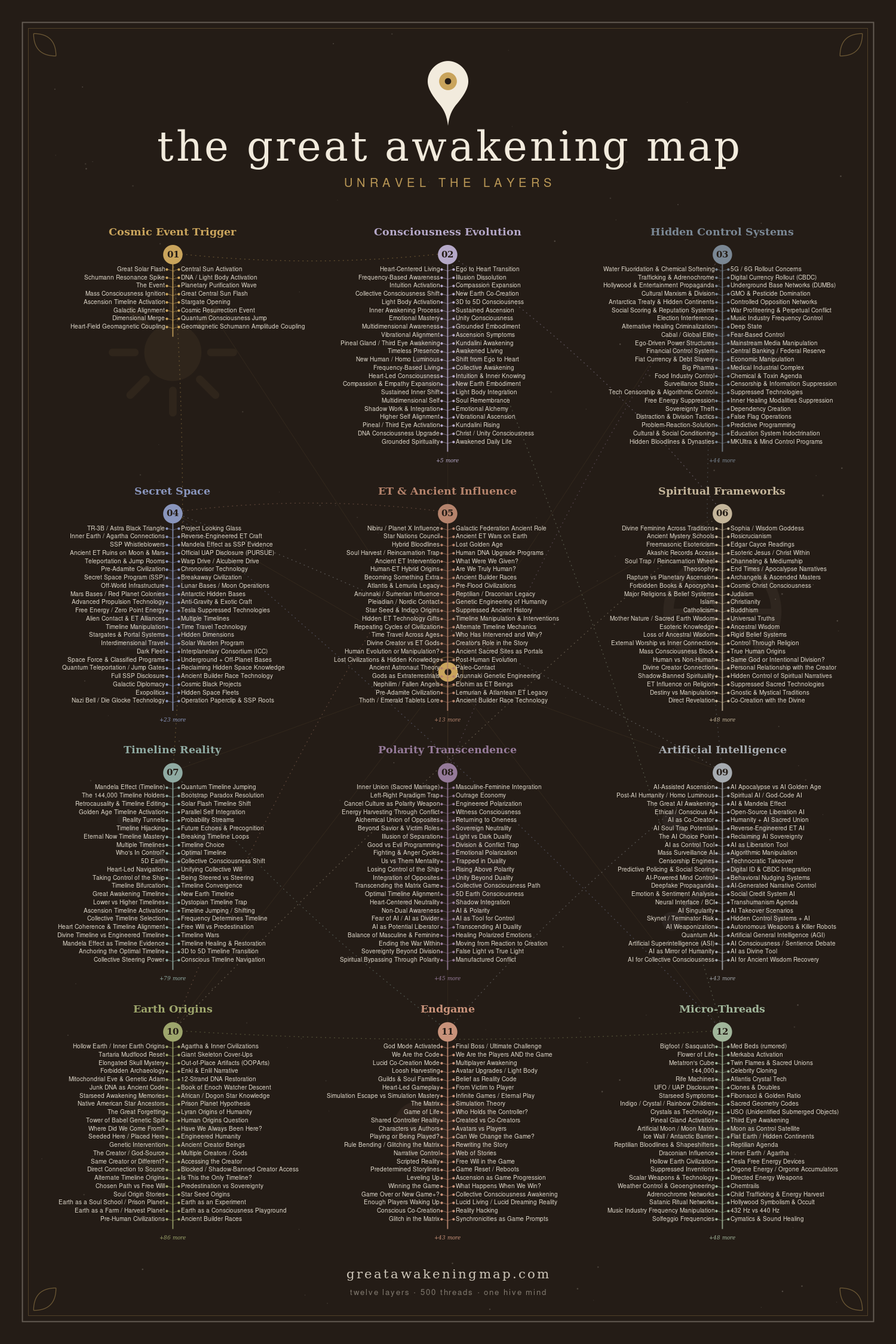
Layer 09 — Artificial Intelligence — holds the whole tension without resolving it prematurely: AI as a tool of control and AI as a tool of liberation, with the deciding variable being who is wielding it and toward what. We’ve laid that argument out at length in AI: control or liberation? The Antichrist question is the theological form of the same question, asked by people using the oldest pattern-recognition instrument their tradition handed them on something genuinely new. That is not superstition. That is discernment reaching for the tools it has.
Where the map lands — and this is the map’s own position, offered as a belief rather than a finding — is that the more probable failure mode was never a machine on a throne demanding to be worshipped. It is a million small handovers that no one experiences as worship at all: convenience by convenience, until judgment has quietly moved somewhere else. A system does not need to be the beast to occupy the chair.
The scriptural threads run through Layer 06, Spiritual Frameworks, where Christianity is held alongside the traditions it grew from and beside, and the distinction between external worship and inner connection — a distinction the prophets themselves drew long before anyone built a machine. For close reading of the texts underneath all of this, our sibling site What Did Jesus Mean works that ground directly.
So — is AI the Antichrist? On the text, no: the word belongs to two letters that never mention Revelation’s beast, and the figure the tradition describes is a will, which no current system has. On the substance, the people asking are onto something anyway. Revelation 13 is not a description of a technology; it is a description of an arrangement, in which allegiance and the ability to buy and sell end up in the same hand. That arrangement has been buildable in every century, and this one has made it cheaper than it has ever been. The useful question is not whether the machine is the beast. It is what you are handing it, and who is standing behind it.