528 Hz is the second-most-discussed tone in the alternative-tuning conversation, after 432 Hz — and the one wrapped in the boldest claims. It's known as the "love frequency," the "miracle tone," and the frequency said to repair DNA. Some of that is overstatement, some of it points at something real, and the difference is worth getting straight before you decide what to do with it. This piece walks through what 528 Hz actually is, what note it corresponds to, the benefits people consistently report, where the DNA-repair story comes from and what to make of it, how 528 compares to 432, and where the tone fits the larger map.
528 Hz meaning at a glance
The fastest answer: 528 Hz is a single tone, not a tuning system. Where 432 Hz describes a whole scale built around a recalibrated reference pitch, 528 Hz usually refers to one specific frequency used on its own — in sound baths, meditation tracks, and tuning forks — or as the reference for a particular tuning called the "Solfeggio" set.
The Solfeggio frequencies are a group of six tones (396, 417, 528, 639, 741, and 852 Hz) revived in the late twentieth century from a reading of a medieval hymn to John the Baptist, where the first syllable of each line was said to encode a tone. 528 sits in the middle of that set and got attached to the ideas of transformation, healing, and — most of all — love. That association is why nearly every search for the 528 Hz meaning returns the phrase "love frequency."
Strip the mythology and what's left is still interesting: a specific, repeatable tone that a lot of people, across very different backgrounds, report having a distinct effect on. Whether the effect is acoustic, physiological, energetic, or some mix is the part worth examining honestly rather than asserting.
What note is 528 Hz
In the standard 440 Hz tuning system, the C above middle C sits at about 523.25 Hz. So 528 Hz is a slightly sharp C — close to C5, but tuned up by a few cycles. In a 432 Hz-based system the math shifts and 528 lands almost exactly on a C, which is part of why the Solfeggio and 432 communities overlap: in that framework, 528 reads as a clean, in-tune C rather than a sharp one.
That detail matters more than it sounds. The fact that 528 falls on or near C — the note most music-theory teaching starts from, the white-key home base of the piano — is one reason the tone feels familiar and resolved to most listeners rather than tense. You don't need to know any of this to feel it. But it explains part of why the frequency lands the way it does.
528 Hz benefits people consistently report
Across sound-healing sessions, meditation apps, and personal experiments, the 528 Hz benefits people describe cluster around a recognizable set of effects — overlapping with 432 Hz but with a distinct emotional flavor.
1. A heart-centered, opening quality. Where 432 Hz is most often described as grounding, 528 Hz is most often described as opening — a warmth that people locate in the chest rather than the belly. This is the single most consistent report and the root of the "love frequency" name.
2. Reduced stress and a calmer nervous system. Like other slow, tonal sound, 528 Hz tracks tend to nudge listeners toward parasympathetic dominance: slower breath, lower felt tension, a quieter internal narration. The mechanism here is well understood and not specific to 528 — sustained, low-complexity tones reliably calm the system — but the effect is real and the reason sound baths work.
3. Easier emotional release. Sound healers report that 528 Hz sessions tend to surface and move held emotional material — often grief or tenderness specifically — more readily than brighter or busier sound. As with 432, the frequency seems to make feeling cheaper, which is usually the precondition for anything actually shifting.
4. Improved focus and a settled mood afterward. Listeners frequently describe a clearer, lighter baseline in the hour after a 528 Hz session — less mental clutter, a steadier mood. This overlaps with the general after-effect of any deliberate quiet listening, but the reports are consistent enough to note.
5. A sense of "tuning toward repair." The hardest to quantify and the most commonly described: people report a felt sense that something is being mended or reorganized, even when they can't name what. The phenomenology is what gave rise to the bigger claims — which is exactly where the topic needs care.
528 Hz music benefits and the DNA-repair claim
Search 528 Hz music benefits and you'll quickly hit the boldest claim attached to any frequency: that 528 Hz repairs DNA. It's worth taking apart carefully, because the honest version is more useful than either the hype or the dismissal.
The DNA story traces mostly to the work of biochemist Glen Rein in the 1980s and to author Leonard Horowitz, who popularized the Solfeggio frequencies and the "miracle tone" framing. Rein's experiments involved playing different kinds of music to test tubes of DNA and measuring changes in how the DNA absorbed UV light — a proxy for structural change. He reported that some musical styles altered the absorption. These were small, preliminary, in-vitro experiments, never replicated at scale, and a long way from showing that a single tone "repairs" DNA in a living body.
So the accurate statement is: there is no robust scientific evidence that listening to 528 Hz repairs human DNA. The claim, stated flatly, is overstated. What is defensible is narrower and still meaningful — that sound and music measurably affect the nervous system, stress hormones, heart rate, and inflammatory markers, and that chronic stress demonstrably damages cells over time. A tone that reliably down-regulates stress is doing something genuinely good for the body's repair systems, just not in the direct, mystical way the headline claims. The route from sound to cellular health runs through the nervous system, not around it.
That's the frame worth holding: 528 Hz isn't a magic wand for your genome, but the thing it actually does — helping a stressed system drop into the state where the body does its repair work — is real, repeatable, and worth using.
528 Hz vs 432 Hz
People who find one of these frequencies usually want to know how it relates to the other. The cleanest way to hold the difference: 432 Hz is a tuning; 528 Hz is a tone.
432 Hz recalibrates the reference pitch (A) for an entire piece of music, so every note shifts and you can listen to full songs "in 432." 528 Hz is most often a single sustained frequency or the anchor of the Solfeggio set, used in meditation and healing contexts rather than for recording your favorite album.
Emotionally, listeners tend to sort them this way: 432 Hz feels grounding, spacious, "coming home to the body"; 528 Hz feels opening, warm, "coming home to the heart." Neither is better. Many people use them for different purposes — 432 to settle and arrive, 528 to soften and open — and a lot of sound-healing sequences move through both. If you're experimenting, the useful move isn't to pick a side but to notice which one your body reaches for in which state.
How to actually use 528 Hz
The practical question is what to do with the tone once you find it interesting.
Use it for heart-centered practice. 528 Hz pairs naturally with anything aimed at the chest and the emotional body — loving-kindness meditation, gratitude practice, journaling about a relationship, sitting with grief. The tone seems to support that work rather than just sit underneath it.
Listen on purpose. As with 432, the effect lands deeper with active, volume-up attention than with low background play. Twenty focused minutes beats hours of wallpaper.
Pair it with breath. Slow nasal breathing layered over a 528 Hz track drops most nervous systems into parasympathetic dominance within five to ten minutes. The frequency does some of the work; the breath does the rest.
Don't oversell it to yourself. Hold the realistic frame — a tone that calms the system and opens the chest — rather than the DNA-miracle frame. Paradoxically, the modest version tends to deliver more, because you're not waiting for fireworks and can actually notice the quiet thing that's happening.
Test it against yourself. Play 528 Hz, then 432 Hz, then silence, and notice what each does in your body on a given day. The only evidence that matters is the one collected inside your own listening.
How 528 Hz fits the awakening map
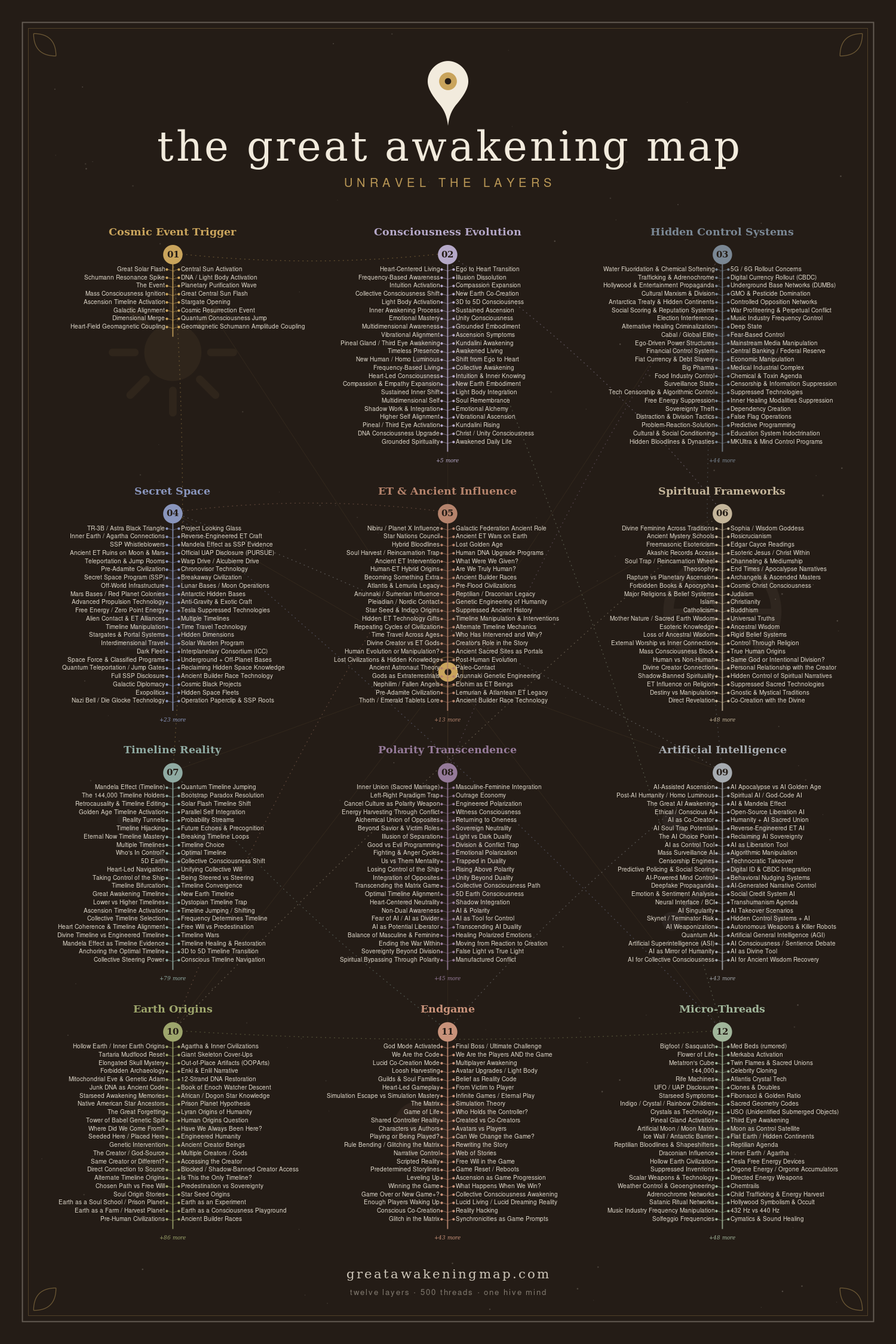
528 Hz sits in Layer 12 of the map — the Micro-Threads — the small, recurring patterns that people reach from radically different starting points. A sound healer, a biohacker reading about heart-rate variability, and a meditator building a playlist all end up sitting with the same tone. That convergence is the data point worth taking seriously, separately from whether the strongest claims around it hold up.
The deeper thread it shares with the rest of the map is the one running under the whole frequency conversation: the body is a more accurate instrument than the discourse usually grants it. When 528 Hz reliably opens something in the chest and settles the nervous system, that's information, regardless of what the marketing says about DNA. The honest move is to keep the real effect and let go of the inflated one — which is exactly the discernment the larger map asks for everywhere, not just here.
Read alongside the Consciousness Evolution layer, 528 Hz is one of many small dials for shifting the body out of the low-grade activation that modern life keeps it in. And it sits right next to its sibling tone: if you haven't yet, the 432 Hz piece covers the tuning question, the 440 controversy, and the cymatics evidence in depth, and the two are best understood together.
The next time a 528 Hz track shows up in your feed, the full picture is available: a single tone near a slightly sharp C, an emotional signature people consistently describe as opening and heart-centered, a "love frequency" name with real phenomenology behind it, a DNA-repair claim that's overstated but points — through the nervous system — at something genuinely worth using, and a place in a numerical and healing lineage older than the recording industry. The tone is one thread among many in the larger Micro-Threads layer — small inputs that, taken together, make the case for paying attention to what the body is being tuned to. Listen. Notice. The instrument you're carrying knows what to do with the information.