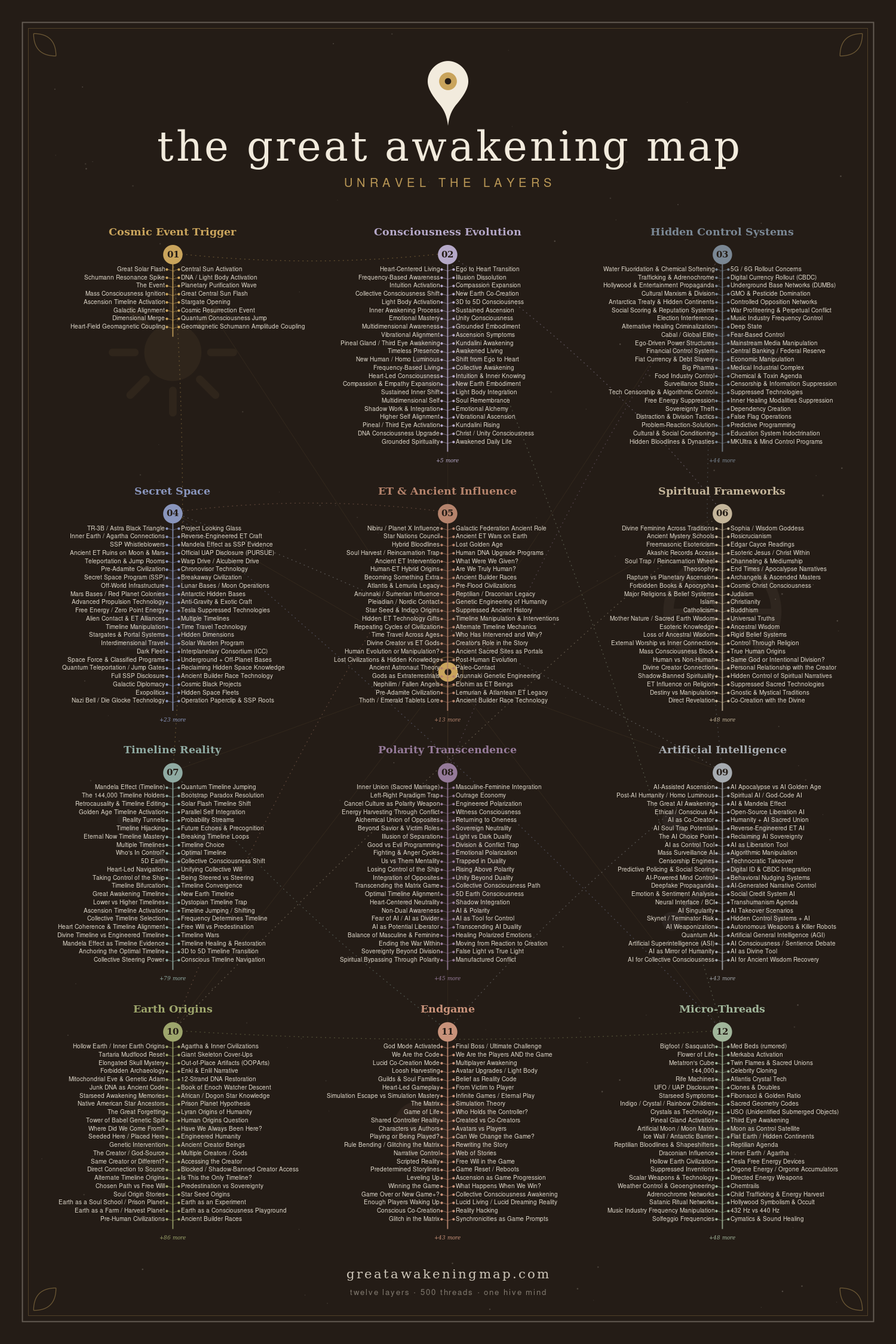

Christ consciousness is a state of awareness — unconditional love, unity, and the felt knowledge that all things are connected — that the figure of Jesus is held to have fully embodied, and that the awakening traditions say is available to everyone. The crucial thing to grasp at the outset: the term is not the property of any one religion, and it doesn't require belief in Christianity to make sense. "Christ" here works less like a surname and more like a title for a level of consciousness — the same level the Buddhists call enlightenment and the Hindu traditions call self-realization. This piece covers what the term actually means, where the idea of the Christ consciousness grid comes from, how a Christ consciousness meditation is meant to work, and why the phrase keeps surfacing now.
What Christ consciousness actually means
The word "Christ" comes from the Greek Christos, "anointed one" — itself a translation of the Hebrew Messiah. In the mystical reading that runs underneath the institutional one, the anointing isn't a coronation but a description of a state: a human consciousness so fully aligned with the divine that the usual wall between the personal self and the source dissolves. On that reading, "the Christ" is not only the name of a man but the name of a possibility — the awakened condition a human being can grow into.
This is why teachers across the esoteric traditions distinguish Jesus, the historical person, from the Christ, the state of consciousness he is said to have realized and demonstrated. Jesus is the example; Christ consciousness is what he was an example of. The same distinction shows up everywhere once you look: the Buddha (the man) versus Buddha-nature (the awakened ground available to all); the realized sage versus the realization itself. The framework treats the great teachers less as objects of worship and more as proofs of concept — evidence of how far human awareness can open.
The qualities of the Christ-conscious state
What does this awareness actually look like? The descriptions converge on a few qualities, regardless of which tradition is doing the describing. Unconditional love — a regard for others that isn't earned, traded, or withdrawn, extended even to enemies. Unity — the direct perception that separation is, at some level, an illusion, and that what you do to another you do, in truth, to yourself. Forgiveness — not as a moral effort but as the natural consequence of seeing past the offense to the person. Inner peace that doesn't depend on circumstances. And a kind of presence that others feel as calming, clarifying, safe.
Read that list and the famous teachings stop sounding like rules and start sounding like reports — descriptions of how reality looks from inside the state. "Love your enemies" is hard advice if you experience yourself as separate from them; it's simply accurate if you don't. This is the move the mystical reading makes again and again: the ethics aren't commands imposed from outside, they're the behavior that falls out naturally once the consciousness shifts.
The Christ consciousness grid
One of the most-searched corners of this topic is the Christ consciousness grid — and it deserves a clear, honest framing. In the energetic cosmology popular in awakening circles, the grid is described as a field of consciousness surrounding the earth: a kind of planetary network that holds and transmits the frequency of unconditional love, which individuals can connect to in meditation and, in connecting, help strengthen. Some accounts tie it to sacred geometry — the idea that the grid has a structure, often described through forms like the geometry of the star tetrahedron — and to the planet's natural energy lines.
It's worth being straight about what kind of claim this is. The Christ consciousness grid is a metaphysical and experiential model, not a measured physical structure — there's no instrument that detects it. Held loosely, though, it's a useful image: it frames the inner work as participation in something collective rather than a private self-improvement project. Whether or not a literal lattice rings the earth, the experience the model points to — that turning toward love measurably changes the field around you, and that this is contagious — is something many people report directly. The map is not the territory, and the grid is best treated as a map.
Christ consciousness meditation
A Christ consciousness meditation is, in practice, a heart-centered practice. The common thread across the many versions: attention is moved out of the analyzing head and into the chest — the heart center — and rested there, often with the felt intention of unconditional love or the silent phrase I am returning to Christ consciousness. Some practices visualize light radiating from the heart outward to others, to the earth, to the grid; some simply hold the question "what would love do here?" and let the nervous system settle into the answer.
The mechanism, stripped of cosmology, is not mysterious. Shifting attention from thought to the body's center of feeling reliably calms the system, softens the grip of the separate, defended self, and makes the qualities above — patience, openness, regard for others — more accessible. You don't have to accept any particular metaphysics for the practice to do something. Whether you read the result as connecting to a planetary field or as down-regulating your threat response and opening the heart, the lived effect points the same direction: more spacious, less reactive, more able to love.
"I am returning to Christ consciousness"
The phrase I am returning to Christ consciousness circulates as an affirmation, and the wording is doing something deliberate. "Returning," not "achieving" — the framework's claim is that this awareness is the native state, not a foreign one. In this telling, separation and fear are the overlay; unity and love are what's underneath, what you were before the conditioning. The work, then, is less about adding something exotic and more about subtracting what obscures — which is why the language is consistently about remembering, uncovering, coming home, rather than acquiring. It's the same instinct behind the higher self: the truest part isn't built, it's recovered.
Why it matters now
The reason the term keeps surfacing in awakening conversations isn't only personal. The collective story the community tells is that humanity is moving through a shift in consciousness — and that Christ consciousness names the destination of that shift at the level of the individual heart. If the larger transition is from fear-based separation toward love-based unity, then "embodying Christ consciousness" is simply what that transition looks like when one person actually undergoes it. It reframes a cosmic-sounding idea as an intimate, daily practice: the global shift is made of millions of private ones, and the only one you can directly do anything about is your own.
How Christ consciousness fits the awakening map
Christ consciousness sits in Layer 06 — Spiritual Frameworks — and it's one of the clearest examples of what that layer holds: the inherited maps of awakening that different traditions have left us. The layer's quiet argument is that these frameworks, for all their surface differences, keep pointing at the same handful of states. Christ consciousness, Buddha-nature, self-realization, unity consciousness — the layer treats these less as competing claims and more as the same summit photographed from different valleys.
Seen that way, the value of the Christ-consciousness framing isn't that it's the right one but that it's a complete one: a named state, a set of qualities, a practice, and a teacher who modeled it. Read alongside the rest of the layer, it becomes a working model of the whole map's premise — that the awakening isn't the invention of a new human capacity but the activation of one the wisdom traditions have been describing, and pointing the way toward, for a very long time.
The fastest way to lose the thread of Christ consciousness is to turn it into a belief to defend or a badge to wear. Its real invitation is plainer and harder: to move attention from the defended head to the open heart, often enough that the qualities of the state — love that isn't earned, peace that isn't bought, the sense that no one is actually separate from you — start to feel less like ideas and more like the room you're standing in. Whether you reach it through the grid, through meditation, or through a single honest moment of forgiveness, the destination is the same, and it was, the tradition insists, always already home.