The Nephilim are a race of giant beings named in the Hebrew Bible, described as the offspring of unions between the mysterious "sons of God" and human women — and their brief, cryptic appearance in the book of Genesis has generated more interpretation than almost any other passage in scripture. The most useful thing to know up front: the canonical Bible says startlingly little, while a non-canonical book — the Book of Enoch — says a great deal, and almost everything dramatic people associate with the Nephilim comes from that second source. This piece covers the actual Nephilim meaning, the role of the Watchers, the giant-bloodline tradition, and the modern claim about how to recognize one.
What the word "Nephilim" means
The name itself is contested, which is fitting for the topic. The most common derivation traces Nephilim to the Hebrew root naphal, "to fall" — hence the frequent gloss "the fallen ones." Some scholars read this as those who fell (morally, or from the heavens); others as those who cause others to fall. A competing line connects the word to an Aramaic term for "giants," which lines up with how the earliest translators handled it: the Greek Septuagint renders Nephilim as gigantes, giants. Both threads — fallen and gigantic — run through every later reading.
The biblical origin: Genesis 6
The entire canonical basis is four verses. Genesis 6 reports that as humanity multiplied, "the sons of God saw that the daughters of men were beautiful, and they took as wives any they chose." Then comes the line: "The Nephilim were on the earth in those days — and also afterward — when the sons of God went to the daughters of humans and had children by them. They were the heroes of old, men of renown." A few verses later, this corruption is given as the reason for the Flood.
Almost everything here is ambiguous, and the ambiguity is the whole game. Who are the "sons of God"? Are the Nephilim the offspring of those unions, or simply people who were already "on the earth in those days"? What does "and also afterward" mean — that they survived the Flood? The text refuses to settle any of it, which is exactly why the interpretive tradition exploded to fill the silence.
Who are the sons of God? Three readings
Centuries of interpretation collapse into three camps. The fallen-angel view — the oldest and most dramatic — reads "sons of God" as divine or angelic beings who crossed a forbidden boundary by mating with humans, producing hybrid offspring. The Sethite view, favored by many later theologians uncomfortable with angel-human unions, reads "sons of God" as the godly male line of Seth and "daughters of men" as the corrupt line of Cain, making the sin intermarriage rather than miscegenation across species. The dynastic-ruler view reads "sons of God" as power-hungry human kings and tyrants who took whatever women they wanted. The first reading is what gives the Nephilim their cosmic, conspiratorial charge; the other two domesticate them.
The Watchers and the Book of Enoch
For the full story — the one most people are actually thinking of — you have to leave the Bible and open the Book of Enoch, an ancient Jewish text that didn't make it into the standard canon but was widely read and is even quoted in the New Testament book of Jude. Enoch turns the four cryptic verses into a detailed myth.
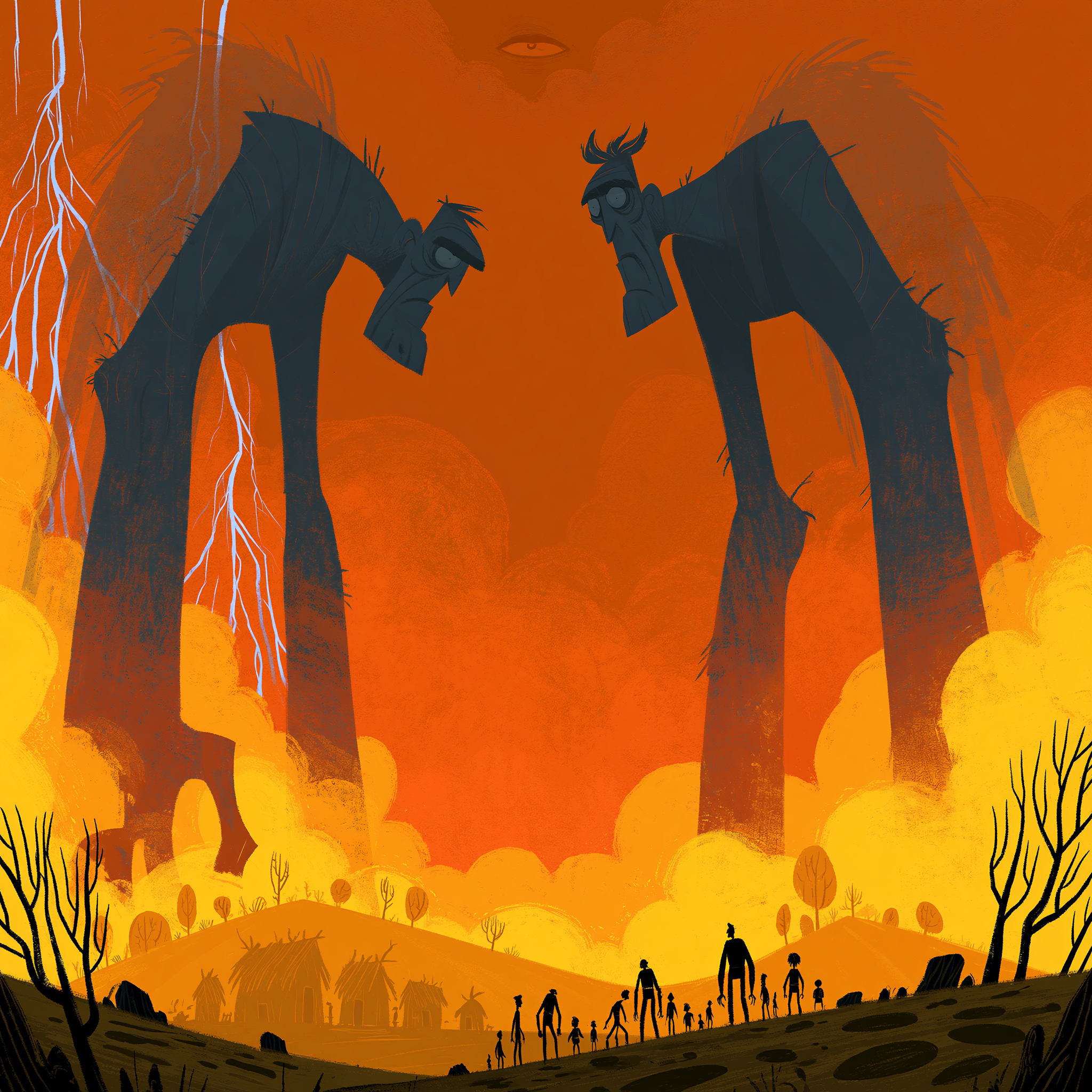
In it, a group of two hundred angels called the Watchers, led by one named Shemihazah (and a second figure, Azazel), descend to earth, take human wives, and father the Nephilim — here depicted as enormous, violent giants who devour the earth's resources and turn on humanity. Worse, the Watchers teach forbidden knowledge: metalworking and weaponry, cosmetics, sorcery, astrology, the secret arts. The result is a world so corrupted that the Flood becomes a cleansing. The phrase "the Watchers" and "Nephilim" are bound together in this text — the Watchers are the fathers, the Nephilim the offspring — and when their giant bodies die, Enoch says, their spirits remain on earth as disembodied evil spirits, a detail later traditions used to explain demons. Nearly every vivid claim about the Nephilim traces back here, not to Genesis.
The giant bloodline that survived the Flood
If the Flood was meant to wipe out the Nephilim, the Bible itself complicates the story — because giants keep showing up afterward. Later books mention the Anakim (descendants of a figure named Anak), whose size makes the Israelite scouts feel "like grasshoppers." Og, king of Bashan, is described as the last of the Rephaim, sleeping in an iron bed of extraordinary length. And Goliath, the Philistine giant David fells, sits in the same tradition of oversized warriors. This is the textual hook for the idea of a surviving Nephilim bloodline — a giant lineage that persisted past the Flood, exactly as Genesis's puzzling "and also afterward" seemed to hint. Whether these are literal descendants or simply tall enemy peoples remembered through legend is, again, left open.
How to recognize a Nephilim
A surprising amount of search traffic asks how to recognize a Nephilim — a question that only makes sense within the modern fringe claim that the bloodline didn't just survive but continues today. In that telling, the traits offered usually include unusual height or physical stature, a tradition of certain physical anomalies (extra fingers or toes, drawn from the biblical description of one of Goliath's relatives with six digits on each hand and foot), and a more esoteric set of "energetic" or behavioral markers — a hunger for power, an absence of conscience, a placement within elite bloodlines. It's worth being clear-eyed here: this is folklore and speculation layered on top of an already ambiguous text, not a documented or testable category. The honest answer to "how do you recognize one" is that there's no reliable way to, because there's no established phenomenon to recognize — what exists is a centuries-deep tradition of reading hidden lineage into human power.
A note on "Fields of the Nephilim"
One more thread worth untangling, because it crosses the search results: Fields of the Nephilim is also the name of an influential English gothic rock band that took the Nephilim myth as their imagery and aesthetic. If you arrived here looking for the music rather than the mythology, that's the band — and it's a clean example of how potent this particular piece of ancient lore has been as a cultural symbol, borrowed by artists precisely because it carries that charge of fallen grandeur and forbidden origin.
How the Nephilim fit the awakening map
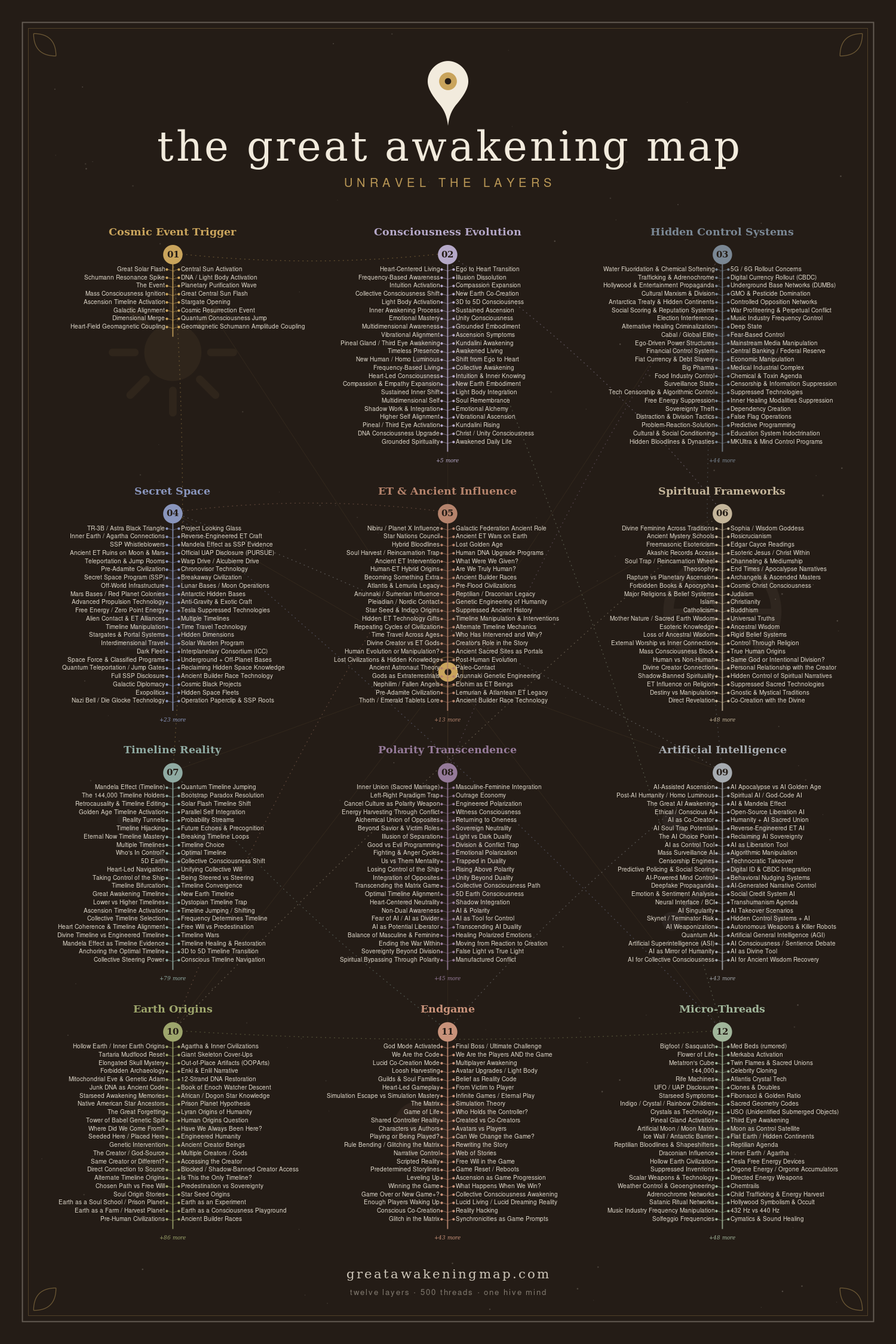
The Nephilim sit in Layer 05 — ET & Ancient Influence — and they're one of the layer's central case studies, because they sit precisely on the seam the whole layer explores: the boundary between "divine beings" and "non-human intelligences." Read through the layer's lens, the Watchers descending from the sky to interbreed with humans and pass on forbidden technology is structurally identical to the modern ancient-astronaut narrative — and to the Anunnaki story drawn from Sumerian tablets, where sky-beings likewise shape humanity. The layer doesn't insist the Nephilim were extraterrestrials; it notices that the shape of the story — beings from above, hybrid offspring, suppressed knowledge, a corrupted bloodline — recurs across cultures that couldn't have copied each other.
That recurrence is the layer's real subject. Whether you read Genesis 6 as garbled history, theological allegory, or literal record, the Nephilim are a clean example of a pattern the awakening map keeps returning to: the persistent human memory of an intervention from outside — something that came down, mixed with us, and changed what we are.
The Nephilim endure not because the Bible says much about them but because it says so little — four verses with the door left open, "and also afterward" hanging in the air. Into that gap rushed the Watchers, the giants, the suppressed knowledge, the surviving bloodline, and finally the modern question of how to spot one walking around today. Held honestly, the meaning is more interesting than any single answer: the Nephilim are the place where scripture admits, almost in passing, that the human story may have non-human authors — and then declines to explain. That refusal is the whole reason we're still talking about them.