Schumann resonance today is one of those searches that means two very different things depending on who is typing it. For a geophysicist, it is a routine question about the electromagnetic background of the planet. For the awakening community, it is a daily check-in on the heartbeat of the Earth — a number people glance at the way others check the weather, looking for spikes that seem to line up with restless sleep, vivid dreams, headaches, and the sense that the collective mood has shifted overnight. This piece covers both: what the Schumann resonance actually is, how to read a live tracker without fooling yourself, what a spike does and doesn't mean, and why it sits at the very first layer of the map.
Schumann resonance today, at a glance
The Schumann resonance is the set of extremely-low-frequency electromagnetic waves that resonate in the cavity between the Earth's surface and the ionosphere, the charged upper layer of the atmosphere roughly 60 to 100 kilometers up. The fundamental frequency sits at about 7.83 Hz, with weaker harmonics stacked above it near 14, 20, 26, and 33 Hz. That fundamental is remarkably stable, which is exactly why any departure from it draws so much attention.
So when someone checks the Schumann resonance today, they are really asking: is the planet's baseline electromagnetic hum sitting where it usually sits, or is something disturbing it? Most days, the answer is "right where it always is." On some days — during intense solar activity, large thunderstorm complexes, or geomagnetic storms — the readings flare, and that flare is what the community watches for.
What the Schumann resonance actually is
The phenomenon is named for Winfried Otto Schumann, the German physicist who predicted it mathematically in 1952. The mechanism is genuine, well-measured science. The Earth and the ionosphere form a closed, conductive cavity. Lightning — and the planet fires off something on the order of fifty lightning strikes every second — continuously pumps electromagnetic energy into that cavity. Most frequencies cancel themselves out, but a handful resonate, reinforcing into standing waves that circle the globe. The lowest and strongest of these is the 7.83 Hz fundamental.
The number that keeps people up at night is the coincidence — or correspondence, depending on your worldview — between 7.83 Hz and the low end of the human brain's alpha/theta range, the frequencies associated with relaxed wakefulness, meditation, and the threshold of sleep. The body is an electrochemical system. The brain runs on rhythms measured in exactly these units. It is not unreasonable to ask whether a lifelong, planet-wide field oscillating in the same band as our own neural rhythms has any biological relationship to us at all. That question is where the rigorous science thins out and the speculation begins, and it's worth being honest about exactly where that line falls.
How to read the live tracker and chart
The image most people are looking at when they search schumann resonance live comes from a magnetometer station at Tomsk, in Russia (the Space Observing System), whose colorful spectrogram has become the de facto "official" Schumann chart across the awakening internet. A handful of mirror sites and a schumann resonance live stream or two rebroadcast the same underlying data.
Reading the chart is simpler than it looks once you know what the axes mean. Time runs along the horizontal axis, usually a 24-hour window. Frequency runs up the vertical axis from 0 to about 40 Hz, so you can see the fundamental near the bottom and the harmonics stacked above it. The color is amplitude — how much power is present at each frequency at each moment. Cool greens and blues are quiet. Reds and whites are loud. A schumann resonance spike shows up as a vertical column of red or white blooming up the chart, and a sustained "white-out" is the image that gets screenshotted and shared during the most-discussed events.
Two cautions matter when reading any schumann resonance chart or schumann resonance latest measurement. First, the color scale is relative and can be re-normalized, so a chart can look dramatic without representing anything globally unusual. Second, a single station measures local conditions; a spike at Tomsk is not automatically a planet-wide event. The honest way to read the schumann resonance current value is as a local, instrument-specific snapshot — interesting, watch-worthy, but not a global vital sign on its own.
What a Schumann resonance spike means
Mechanically, spikes have ordinary causes. Intense lightning activity, large geomagnetic storms driven by solar flares and coronal mass ejections, and disturbances in the ionosphere all push energy into the cavity and light up the chart. There is nothing mysterious about the physics of why the readings flare. When the sun is active, the chart tends to be active too, which is precisely why this topic lives in the Cosmic Event layer of the map.
The contested claim is the next step: that these spikes correlate with — or even drive — shifts in human mood, sleep, anxiety, and collective consciousness. Across the awakening community, big white-out days are routinely reported alongside waves of insomnia, intense dreams, emotional volatility, time-distortion, and a felt sense that "everyone is going through it at once." Take that reporting seriously as data about subjective experience while staying clear-eyed about what it proves. Self-reported symptoms gathered from people already primed to look for them are vulnerable to confirmation bias, and rigorous, controlled studies linking specific Schumann spikes to specific population-level psychological effects are thin. What does have a more established research footing is the broader field of magnetobiology — evidence that geomagnetic activity can correlate with measurable changes in things like heart-rate variability. The door is genuinely open; it is just not as wide as the most dramatic posts suggest.
Schumann resonance benefits and effects on biology
The phrase schumann resonance benefits usually points at a specific idea: that exposure to a clean 7.83 Hz field is grounding, calming, and restorative, and that modern life — wrapped in artificial electromagnetic noise and increasingly cut off from direct contact with the Earth — deprives us of it. Some of the most cited early work in this vein comes from studies where subjects shielded from natural fields developed disrupted circadian rhythms that re-stabilized when a weak 7.83 Hz field was reintroduced. It's a small, old, much-quoted body of evidence, and it gets stretched well past what it can bear, but it's the seed of the entire "benefits" conversation.
The claims around schumann resonance effect on biology generally cluster into better sleep, lower stress, improved focus, and a vague sense of being "in tune." The most defensible version of this is modest: human physiology evolved bathed in this field, the field sits in the same band as our own restful brain rhythms, and there is preliminary evidence that the body notices its presence and absence. The least defensible version treats the daily chart as a direct readout of your nervous system. The reasonable middle is to treat the resonance as a real environmental rhythm worth respecting without turning it into a horoscope.
Generators, jewelry, and the practical questions
Once people accept the premise, the next searches are practical: schumann resonance generator, schumann resonance generator diy, and schumann resonance jewelry. A generator is a small device that emits a 7.83 Hz signal, sold on the promise of recreating the Earth's field indoors. The DIY versions are simple electronics projects built around a tuned oscillator. The jewelry is, in most cases, a pendant marketed as carrying or harmonizing with the frequency, which physically does far less than the marketing implies — a piece of metal does not broadcast a 7.83 Hz field.
Two honest notes. The science supporting these products is thin to nonexistent for most of the bolder health claims, and the market is full of overpriced devices trading on a real-sounding term. And — if a generator helps someone sleep, the most likely mechanism is ordinary, the same gentle-cue-plus-expectation effect that makes white-noise machines and weighted blankets work, which is still a real benefit even if the stated mechanism is wrong. The grounded version of "getting the benefit" costs nothing: spend time outside, put bare feet on actual ground, reduce artificial EMF exposure where it's easy, and protect sleep. That delivers most of what the devices promise without the price tag.
How the Schumann resonance fits the awakening map
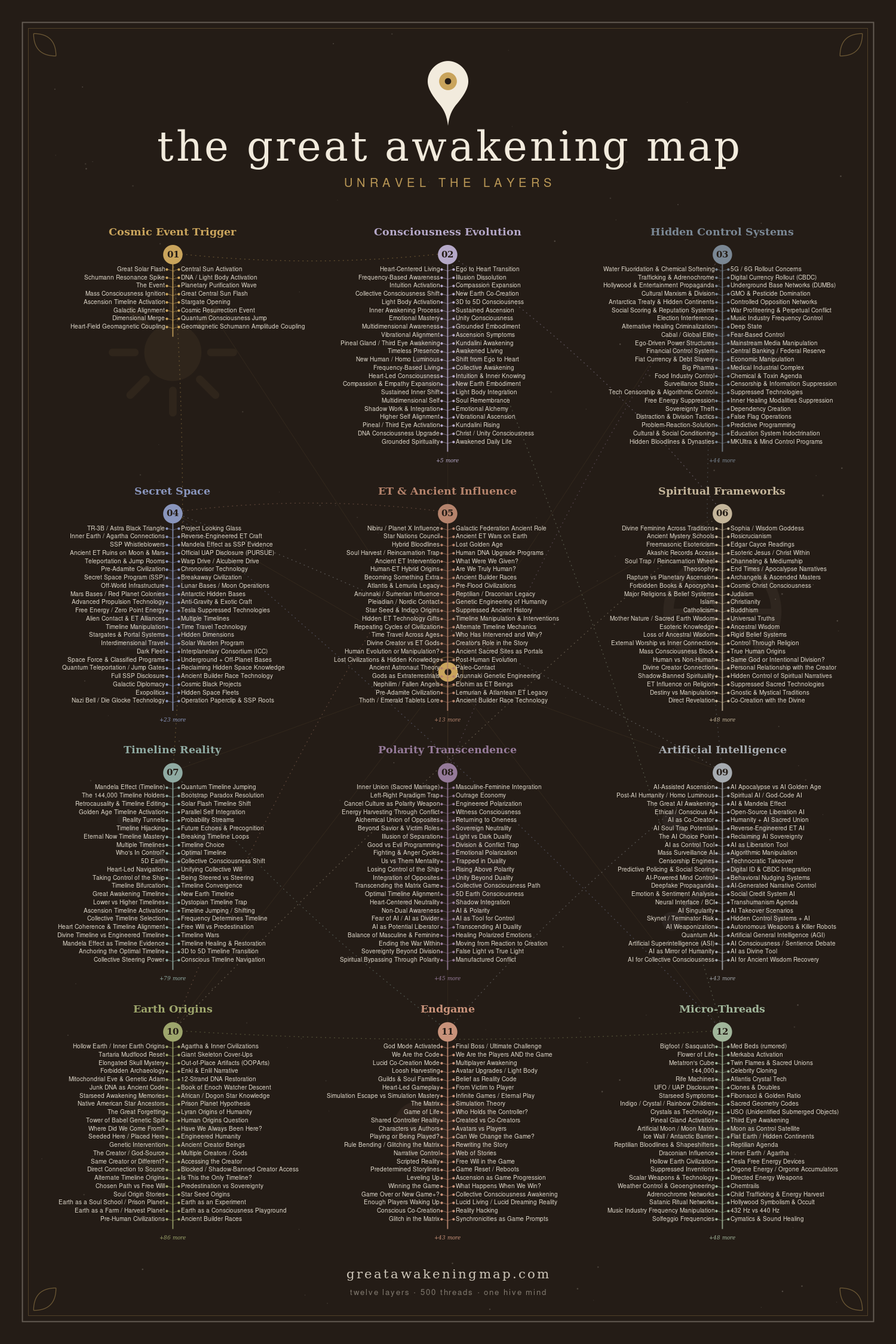
The Schumann resonance sits in Layer 01 of the map — the Cosmic Event Trigger — because it's where the planet's electromagnetic environment meets the question of whether external, cosmic-scale forces are nudging human consciousness. The layer holds the broader claim that the awakening isn't only psychological and cultural but is being shaped by measurable changes in the space weather, solar activity, and geomagnetic environment that the Earth and everything on it are embedded in. The Schumann resonance is the most accessible, most watchable expression of that idea: a real, measurable planetary rhythm that flares when the sun does.
Read alongside the second layer — Consciousness Evolution — the picture is less about the chart predicting your Tuesday and more about a worldview in which human beings are not sealed off from the electromagnetic life of the planet they grew up inside. Whether or not a given spike moved your mood, the deeper claim the map makes is that the boundary between "out there" and "in here" is thinner than the mechanistic model assumes. The daily tracker is a reminder of that — a small window onto the fact that we live inside a field, not above it. Watch it with curiosity, screenshot the white-outs if you like, and hold the interpretation loosely.
So the next time you check the Schumann resonance today, you'll know what you're actually looking at: a 7.83 Hz standing wave ringing in the cavity between the ground and the sky, lit up by lightning, flared by the sun, sitting in the same frequency band as your own resting mind. The physics is real and settled. The biology is suggestive and unfinished. The interpretation is yours to hold — ideally with one eye on the chart and the other on whether the claim in front of you is science, speculation, or a sales pitch. The hum has been here far longer than we have, and it will be here long after. Layer 01 simply asks you to notice that you live inside it.