
The "third eye" is the traditional name for the center of perception associated with the brow — the ajna chakra in the yogic system, often linked to the pineal gland in the body. When people ask how to know if your third eye is open, they're usually somewhere in the middle of an experience they don't have words for yet: a shift in how vivid things feel, a pressure between the brows, intuition that's suddenly louder. This piece gives an honest answer — the clearest signs, the side effects worth knowing about, how to open it with and without meditation, and why "fast" is the wrong thing to want.
How to know if your third eye is open at a glance
The fastest answer: an open third eye shows up as a quiet but persistent increase in inner perception — stronger intuition, more vivid inner imagery, a felt sensitivity to the energy of people and places, and a sense of perceiving slightly more than the five senses are reporting. It's rarely dramatic. People expecting literal visions usually miss the real thing, which is subtler and steadier: the world gets a little more transparent, and your inner knowing gets harder to argue with.
One useful distinction up front: an opening third eye and an open one feel different. Opening tends to come with intensity — pressure, sensitivity, emotional surfacing. An integrated, open third eye feels calmer: the heightened perception is just there, woven into ordinary awareness, no longer a disruption. Where you are on that arc changes which signs you'll notice.
Signs your third eye is opening
The most reliable signs your third eye is opening cluster into a recognizable set. Few people get all of them; most notice several.
1. Pressure or tingling between the brows. The most-reported physical sign — a dull pressure, warmth, or subtle tingling at the brow point, sometimes during meditation, sometimes at random. This is the sensation people most often mean when they say they "feel" their third eye.
2. Sharper, more accurate intuition. You start knowing things before you have a reason to — reading a room correctly, sensing what's about to happen in a conversation, getting clear hits about people that turn out right. The key word is accurate: not anxious guessing, but a quiet knowing that earns your trust over time.
3. More vivid inner imagery and dreams. Mental images get crisper, daydreams more detailed, and dreams more lucid, symbolic, or memorable. Some people start seeing colors, geometric patterns, or soft light with eyes closed in meditation.
4. Heightened sensitivity to energy and environments. You notice the "feel" of a room the moment you enter, pick up on others' moods more strongly, or feel drained or lifted by particular people and places. The boundary between your state and the room's gets thinner.
5. Increased synchronicities. Meaningful coincidences pick up — the right book, the repeated number, the person who appears at the right moment. (If repeating numbers are part of yours, the 555 and 333 threads cover that pattern directly.)
6. A pull toward stillness and away from noise. A growing aversion to overstimulation — loud environments, doomscrolling, constant input — and a corresponding pull toward quiet, nature, and practices that let the inner sense come forward.
7. A felt sense of expanded awareness. The hardest to describe and the most significant: a quiet recognition that you're perceiving from somewhere slightly behind or above your usual vantage point — more witness, less reactor. That shift in vantage is, in many traditions, the whole point.
Third eye opening side effects
Searches for third eye opening side effects and side effects of opening your third eye are common for a good reason: opening too fast, or without grounding, has a real downside, and it's better to know the terrain than to be blindsided by it.
Headaches or brow pressure. The most common side effect — pressure at the brow or forehead that can tip into a headache, usually when you've been pushing intense practice without enough rest or grounding. It typically eases when you slow down.
Overwhelm and sensory flooding. Heightened sensitivity is wonderful until it's too much. People who open quickly often describe feeling raw — over-affected by other people's emotions, unable to filter input, drained in crowds. The sensitivity isn't the problem; the missing filter is, and it develops with time and grounding.
Sleep disruption and vivid, intense dreams. Especially early on, sleep can get lighter and dreams more turbulent as a lot of inner material moves. This usually settles.
Anxiety or destabilization. Perceiving more than you can yet integrate can be unsettling. If the inner world opens faster than your capacity to hold it, the result can be anxiety or a shaky sense of what's real. This is the clearest signal to slow down — and, if it's significant, to get support from a teacher, therapist, or experienced guide rather than pushing through alone.
Discernment problems. A subtler one: a newly active third eye can make every passing impression feel meaningful, and not every impression is. The skill that has to grow alongside the opening is discernment — telling a real intuition from a projection, a fear, or wishful thinking. Without it, an open third eye can mislead as easily as it guides.
None of these mean something has gone wrong. They mean the system is opening faster than it's integrating, and the answer is almost always the same: slow down, ground, and let capacity catch up.
How to open your third eye
If you want to open your third eye deliberately, the traditional methods are well-worn and they work — gradually, which is the point.
Brow-point meditation. The core practice: sit comfortably, rest your attention gently at the brow point (no straining the eyes upward), and keep returning there. Ten to twenty minutes a day, consistently, does more than occasional long sessions.
Breathwork. Slow, rhythmic breathing settles the nervous system and makes the subtle perception easier to notice. Steady nasal breathing with soft pauses works; more intensive techniques exist but are better learned with a teacher.
Sound. Tones and chanting are traditional aids — the seed sound "Om," and frequencies like 432 Hz and 528 Hz, are commonly used to support brow-point practice. Sound gives the attention something to rest on and helps drop the system into the receptive state.
Reducing what dulls it. Much of the traditional pineal/third-eye work is about removal as much as cultivation — less screen time, less overstimulation, less of what keeps attention pinned to the surface. The pineal gland and third eye piece goes deep on the physical side of this.
Time in nature and darkness. Quiet, low-stimulation environments — especially natural ones and genuine darkness — let the inner sense come forward in a way that a busy, lit, noisy environment actively suppresses.
How to open your third eye without meditation
A lot of people search how to open third eye without meditation — either because formal meditation hasn't clicked or because they want approaches that fit a normal day. The honest answer is that you can absolutely cultivate the third eye without sitting practice, but "without any inner attention at all" isn't really possible, because attention is the instrument. Here's what works outside a formal sit.
Intuition practice in daily life. Start trusting and testing small hunches — which line will move faster, who's about to text, how a meeting will go. Acting on quiet hits and tracking the results trains the faculty directly, no cushion required.
Creative flow. Sustained creative work — art, music, writing, movement — opens the same receptive, inner-imagery channels that brow-point meditation does. Flow states are third-eye states by another name.
Time in nature, attention outward and soft. Walking without headphones, attention relaxed and wide rather than narrowed onto a screen, is a practice even if no one calls it one.
Visualization and dream work. Deliberately picturing scenes in detail, and keeping a dream journal, both strengthen the inner-imagery muscle the third eye uses.
Removing the suppressors. Cutting overstimulation, reducing screens, and getting real darkness at night do a surprising amount of the work on their own — by getting out of the way of a faculty that's largely been buried, not absent.
How to open your third eye fast — and why slow is better
The most-searched version of this whole topic is some form of how to open your third eye fast or fastest way to open third eye — and it's worth answering directly: the desire for speed is the single most common way people get hurt here.
It's true that intense methods — aggressive breathwork, long retreats, certain substances — can force a rapid opening. The problem is that opening and integration are different processes, and forcing the first without the second is exactly what produces the destabilization, overwhelm, and discernment problems described above. An opening you can't integrate isn't an asset; it's a liability you then have to spend months grounding back down.
The faculty you're cultivating is one of perception and discernment, and discernment specifically cannot be rushed — it's built by accumulating experience of which inner signals are trustworthy, and that takes the time it takes. The people who end up with a genuinely useful, stable, open third eye are almost always the ones who went slowly: daily practice, good grounding, patience with the plateaus. "Opening slowly" isn't a consolation prize. It's the actual path. Treat any method promising instant results with the caution you'd bring to anything else promising to skip the work.
How the third eye fits the awakening map
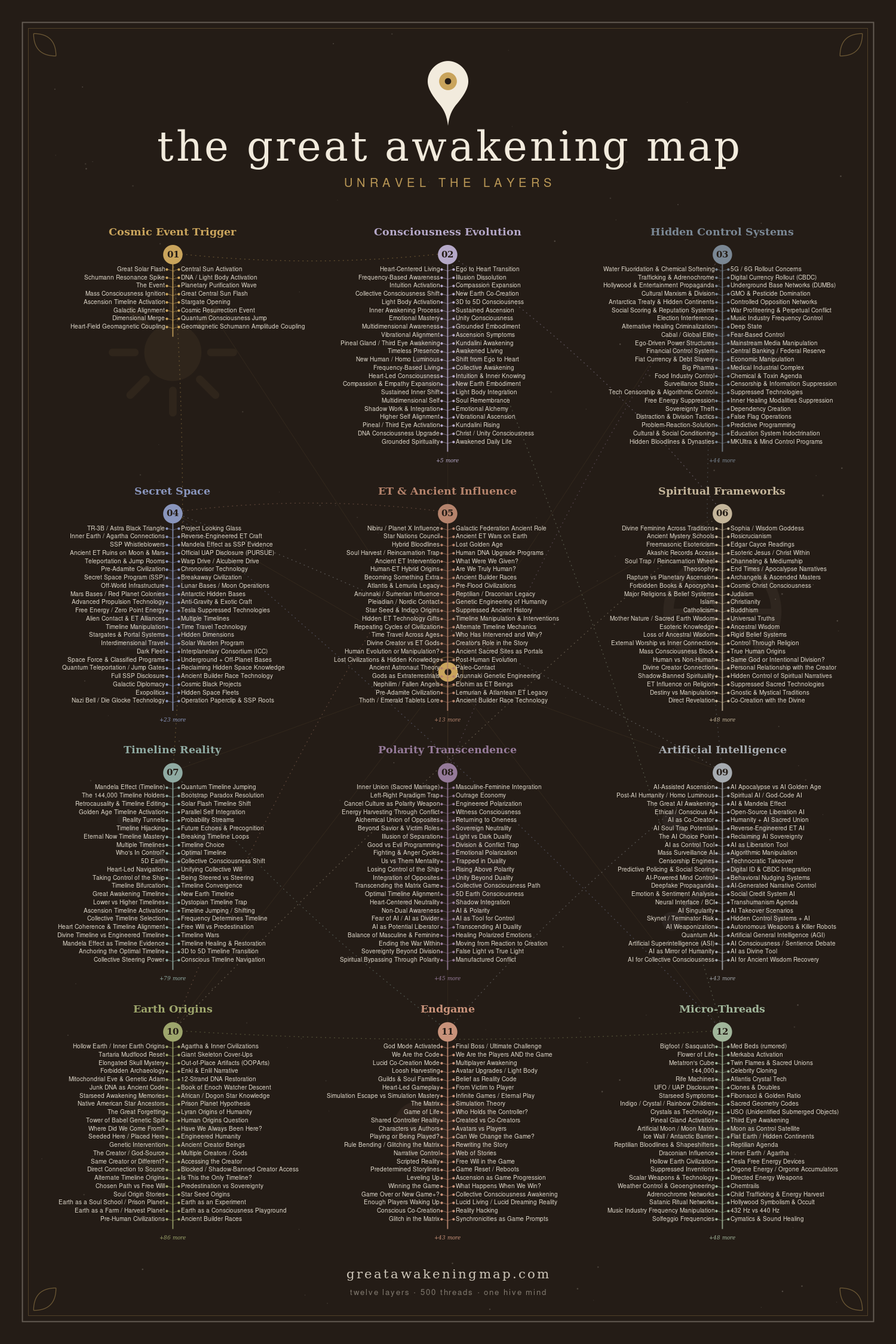
The third eye sits across two layers of the map. As a Micro-Thread (Layer 12) it's one of the small, recurring patterns people reach from radically different starting points — a yoga student, someone reading about the pineal gland, and someone who just started noticing synchronicities all converge on the same brow-point experience. And it threads directly into the Consciousness Evolution layer, where the larger story is about perception itself expanding.
The thread it shares with the rest of the map is the one running under the whole topic: the body is a more accurate instrument than the discourse usually grants it, and most people are running it with the inner sense turned almost all the way down. Opening the third eye, in the grounded reading, isn't acquiring a superpower — it's turning a dial back up that modern life has quietly turned down through overstimulation, constant input, and the loss of darkness and stillness. Which is also why the honest version of this work is as much about removing what suppresses the faculty as about adding practice.
For the physical layer of all this — the pineal gland, calcification, light, and what to actually change in your environment — the pineal gland and third eye thread is the companion piece, and the two are best read together.
So, how do you know if your third eye is open? Not by visions on demand, but by the quieter evidence: pressure at the brow, intuition that earns your trust, vivid inner imagery, a thinning boundary between you and the rooms you enter, and a steady pull toward the stillness where the inner sense can come forward. Know the side effects, respect them as signals to slow down, choose practices you can integrate, and ignore anything promising to get you there fast. The third eye is one thread among many in the larger Micro-Threads layer — small shifts in perception that, taken together, make the case that there's more available to ordinary awareness than the surface of a busy day suggests. Turn the noise down. The dial turns up on its own.