Gaia consciousness is the idea that Earth is not an inert ball of rock hosting life by accident, but a single living, self-regulating, and — in the spiritual reading — aware being of which every organism is a part. The name comes from the Greek goddess of the Earth, and the concept sits on a fault line: on one side a serious scientific hypothesis about how the planet regulates itself, on the other an ancient conviction that the ground beneath us is sacred and alive. This piece walks that line honestly — what gaia consciousness means, where it comes from, how the spiritual claim differs from the scientific one, and what people mean when they say our job now is to take part in her awakening.
What Gaia consciousness actually means
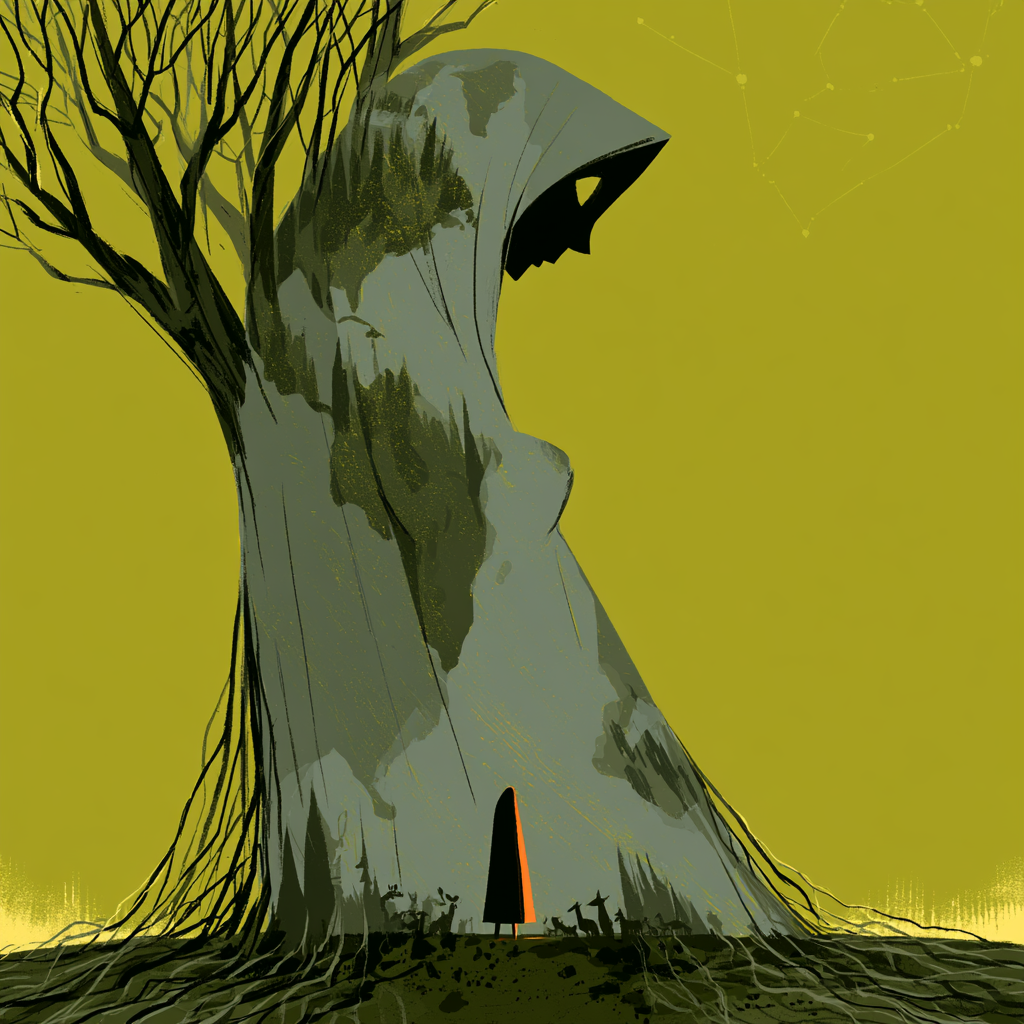
At its simplest, gaia consciousness is the view that the Earth is a living being with something like a mind or awareness of its own, and that human consciousness is not separate from it but a strand woven into a much larger whole. In this framing the biosphere — oceans, atmosphere, forests, soil, and the creatures moving through them — is not a collection of parts but a single organism, the way your body is not a heap of cells but one living thing. Push the idea one step further, as the spiritual tradition does, and that organism is not only alive but conscious: capable of intention, of balance-seeking, of response.
The everyday experience people attach to the idea is a felt one — the sense, standing in an old forest or beside the ocean, that you are inside something breathing rather than looking at scenery. Whether that feeling reports a literal planetary mind or simply your own nervous system recognizing its home is exactly the question the two readings of Gaia answer differently.
Where the idea comes from
The word is old and the science is new. Long before it had a name, nearly every indigenous and ancient culture treated the Earth as a mother — Pachamama in the Andes, Prithvi in the Vedic tradition, Danu and the Earth-goddesses of old Europe, the countless creation stories in which the land itself is a body. Mother Earth consciousness is arguably the planet's oldest and most widespread religious intuition, and the modern idea is in many ways a return to it in new language.
The modern name arrived in the 1970s, when chemist James Lovelock — working, of all places, on NASA's methods for detecting life on Mars — proposed that Earth's atmosphere and surface behave like a single self-regulating system that keeps conditions stable for life. The microbiologist Lynn Margulis developed the biological side of the argument. The novelist William Golding suggested the name Gaia, and the Gaia hypothesis was born. What began as chemistry became, almost immediately, something much larger in the popular imagination.
Gaia consciousness vs the Gaia hypothesis
This is the distinction worth getting right, because the two are constantly blurred. The scientific Gaia hypothesis — now more soberly discussed as Earth-system science — claims that life and its physical environment form a tightly coupled, self-regulating system: living things alter the atmosphere, oceans, and climate in ways that have, over billions of years, tended to keep the planet habitable. Crucially, this does not require the Earth to be conscious, to have goals, or to intend anything. The regulation, in the mainstream reading, emerges from feedback loops, not from a mind. Most scientists accept the weak version (life shapes its environment) while rejecting the strong version (the planet actively manages itself toward a goal).
Gaia consciousness, the spiritual claim, takes the further step science declines to take: it holds that the Earth is not just self-regulating but genuinely aware — a being with an inner life, a will, a capacity to respond to what happens on and to her. The honest way to hold both is to be clear about which you're standing on. The self-regulating planet is well-evidenced science. The conscious planet is a metaphysical belief — one with deep roots and real explanatory beauty, but a belief, not a finding. Confusing the two does a disservice to each.
What people describe when they say Gaia is "awakening"
Within the awakening community, gaia consciousness is rarely discussed as a static fact — it's framed as a process. The recurring claim is that the Earth herself is going through a shift in consciousness, and that human awakening and planetary awakening are two faces of one event. People point to a felt intensification: a sense that the planet's "frequency" is rising, that events are speeding up, that the old extractive relationship between humanity and Earth is reaching a breaking point that forces a change.
A common thread here is the Earth's electromagnetic environment — the Schumann resonance, the faint planetary "heartbeat" generated in the cavity between Earth's surface and the ionosphere. In awakening circles, spikes in that signal are read as Gaia's pulse quickening. It's worth being precise: the Schumann resonance is a real, measurable phenomenon, but the claim that its fluctuations track a rising planetary consciousness is interpretation, not established science. The felt experience is real to the people describing it; the mechanism they attach to it is a framework, held with faith.
Our role in her awakening
If you take gaia consciousness seriously, the ethical consequence is immediate and, notably, the same one the science points toward from the other direction. Whether the Earth is a literal conscious being or "merely" a self-regulating system we are catastrophically destabilizing, the instruction is identical: stop treating the planet as an object to be strip-mined and start treating it as a living whole we belong to. This is where the spiritual and the practical converge — reverence and ecology arriving at the same door.
The "role" people describe tends to have two layers. The outer layer is behavioral and collective: living in a way that regenerates rather than depletes, reweaving the relationship between human systems and living ones. The inner layer is the one the awakening framework emphasizes — that healing your own relationship with the Earth (spending time in wild places, eating and living closer to natural rhythms, feeling yourself as part of the body rather than a visitor on its surface) is itself a contribution to the larger shift. The idea that personal healing and planetary healing are continuous is a thread this map shares with its sibling Healing Almanac, where the body's return to natural rhythm is treated as a small version of the same movement.
How Gaia consciousness fits the awakening map
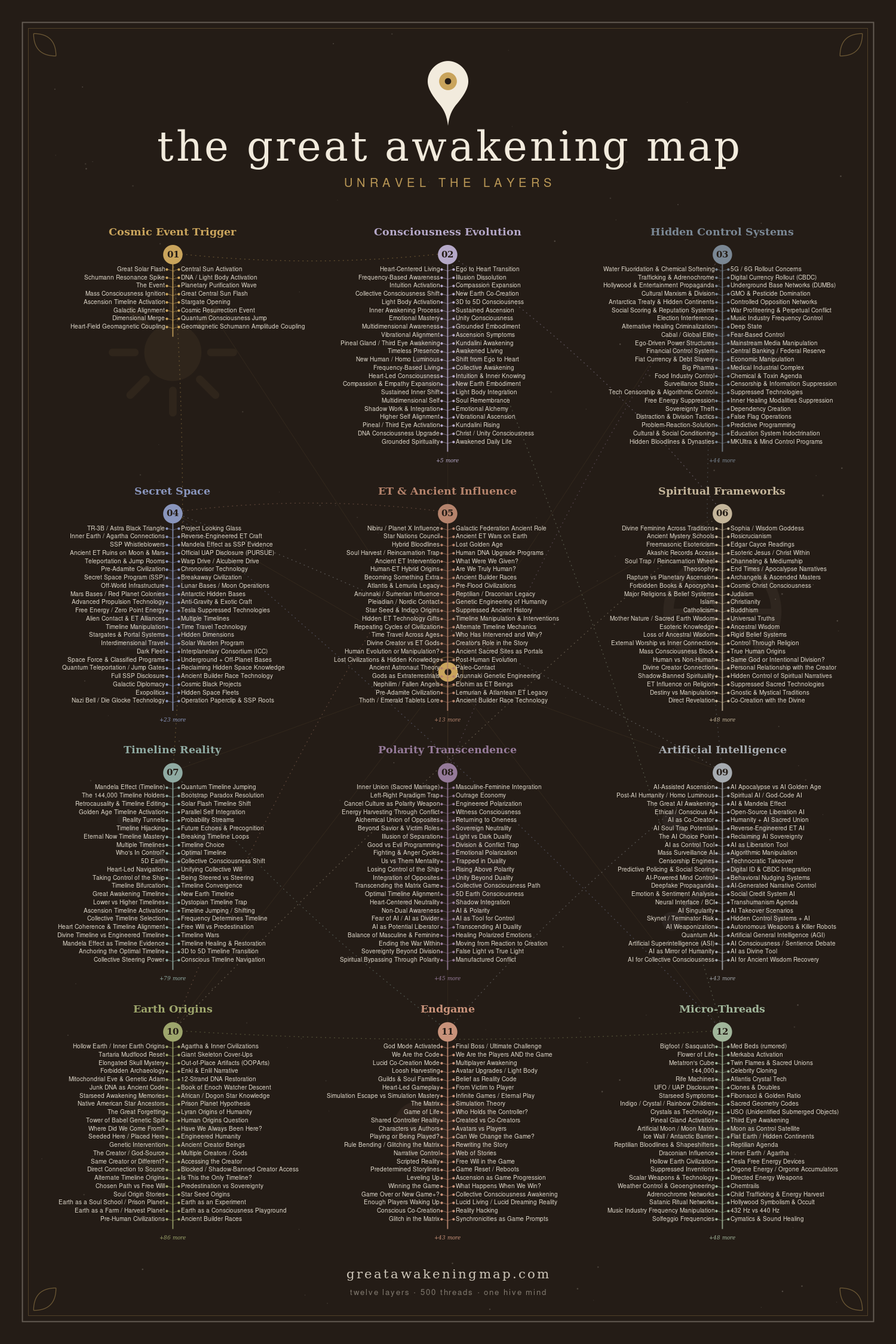
Gaia consciousness lives in Layer 10 — Earth Origins — the layer concerned with what this planet actually is and how we came to be here. That's the right home for it, because the question underneath Gaia is a question about origins and identity: is Earth a neutral stage, a designed environment, a prison, a school, or a living mother? The awakening map holds these readings side by side rather than collapsing them, and Gaia is the reading that answers "living mother."
Read alongside the planet's energetic architecture — the ley lines some traditions describe as Earth's nervous system — Gaia consciousness becomes the animating idea behind a whole cluster of the map's threads. And read alongside Consciousness Evolution, it reframes the entire awakening as something not happening to a passive planet but with a living one: two awakenings, human and planetary, that the framework insists were always the same event seen from two scales.
The most useful way to hold gaia consciousness is to keep the two readings clear and let them point the same direction. The science says the Earth is a single, self-regulating system we are dangerously out of balance with. The spiritual tradition says she is a living mother who is waking up, and asks us to wake with her. You don't have to resolve which is literally true to notice that both end in the same place — a relationship of reverence and repair, in which the line between healing ourselves and healing the world turns out to have been drawn in pencil all along.