The choice between service to self and service to others is, in the framework it comes from, the single most consequential orientation a soul can take. It comes chiefly from the Law of One material, where the two are called the two "polarities" — the positive path (service to others) and the negative path (service to self) — and both are described, controversially, as valid routes toward spiritual advancement. This piece lays out what each path actually means, why the framework refuses to reduce it to a simple good vs evil, where the widely-misunderstood "51%" and "95%" thresholds come from, and how the whole polarity fits a map whose eighth layer is about seeing past exactly this kind of division.
Where the idea comes from
The language of service to self vs service to others is most closely associated with the Law of One (the "Ra material"), a series of channeled dialogues from the early 1980s that became foundational to a large stream of modern esoteric thought. In that cosmology, a soul evolving through the densities of consciousness eventually reaches a crossroads where it must "polarize" — choose a dominant orientation — in order to keep growing. The two available polarities are service to others and service to self. Similar distinctions appear across older traditions under different names — the left-hand and right-hand paths, for instance — but the crisp, modern framing that people search for today traces to the Law of One.
It's worth saying plainly: this is a metaphysical framework drawn from channeled material, not an empirical claim. We present it as the coherent system it is, the way you'd explain any body of esoteric thought — because understanding what its adherents actually believe is more useful than either endorsing or dismissing it.
What service to others means
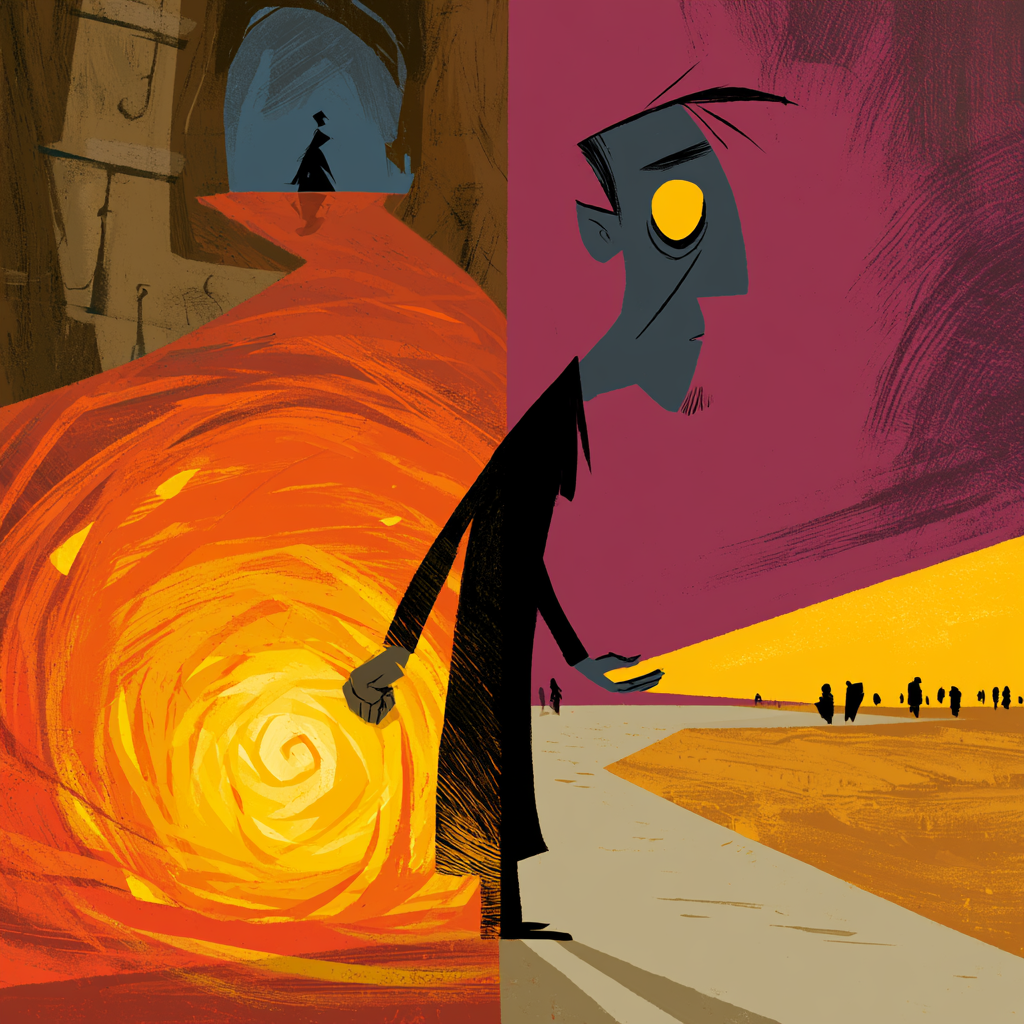
Service to others — the positive polarity — is the path of radiance: an orientation in which the self grows by giving, loving, and serving the whole of which it's a part. Its logic is unity. The service-to-others soul increasingly experiences other beings not as separate competitors but as extensions of one consciousness, so that helping another and helping oneself stop being different acts. Compassion, acceptance, and the free-willed offering of love without demand are its hallmarks. In the framework, this is the path most spiritual traditions point their followers toward, and the one described as the smoother — though not necessarily faster — road home to Source.
The subtle point the framework is careful about: genuine service to others is not self-erasure or martyrdom. Giving from depletion, or serving others to be seen doing it, is service to self wearing a helpful mask. The positive path requires a whole self to give from — which is why the tradition treats healthy self-respect as a prerequisite for real generosity, not its opposite.
What service to self means
Service to self — the negative polarity — is the path of magnetism: an orientation in which the self grows by acquiring, controlling, and drawing everything toward its own center. Its logic is separation. The service-to-self soul experiences itself as fundamentally distinct from and above others, and pursues advancement through mastery, will, and the ordering of others beneath it. In the framework this is a genuinely difficult path — it demands ruthless self-discipline and near-total control — and it is described as workable but far harder and lonelier, a road that eventually hits a ceiling because separation can only take a soul so far before it must, in the end, turn back toward unity.
This is where the framework diverges sharply from ordinary morality, and where it makes many readers uncomfortable. It does not call service to self "evil" in a cartoon sense; it calls it a coherent, if harsh, evolutionary strategy that becomes destructive when it acts on others without their consent. The manipulations of what this map elsewhere calls the hidden control systems are, in this reading, service-to-self polarity operating at a civilizational scale — and its structures of secrecy and control are exactly what the negative path looks like when it runs a world.
Why it isn't simply good vs evil
The hardest and most distinctive claim in the whole framework is that service to self is a valid path — that both polarities are ways of concentrating spiritual energy and both, ultimately, lead back to the one Source, just by very different routes and over very different timescales. To a conventional moral intuition this sounds like relativism or worse. But the framework's point is subtler than "anything goes." It's that the universe is built to let free will explore every orientation, including the harmful one, and that even the negative path is a form of learning that eventually exhausts itself and reverses.
This is precisely the kind of claim Layer 08 exists to sit with rather than rush past. You can find the idea liberating (it dissolves fear-based dualism and returns everything to one source) or dangerous (it can be used to rationalize harm as "just another path"). Both reactions are worth taking seriously. The map's position isn't to tell you which is right, but to show you the whole structure clearly enough that you can navigate it with eyes open — including its risks.
The 51% and 95% thresholds
Two numbers circulate constantly in discussions of this topic, usually without their context. In the Law of One framework, to "graduate" from this density on the service-to-others path, a soul must become roughly 51% oriented toward others — a slim majority, the point being that the positive path asks for a genuine tilt toward love, not perfection. The service-to-self path, by contrast, is said to require around 95% orientation toward self — a near-total commitment, reflecting how much harder and more absolute the negative road is. The asymmetry is the teaching: it is far easier to graduate through love than through control, because love works with the grain of a universe the framework describes as fundamentally one.
How the choice shapes a soul
What makes this more than cosmology-trivia is the mirror it holds up to ordinary life. Stripped of the channeled vocabulary, service to self vs service to others is a question you answer in small increments every day: do you move through a given moment gathering toward yourself or opening toward others? The framework's insight is that these micro-choices accumulate into an orientation, and the orientation into a trajectory. You are, in this reading, always polarizing — the only question is in which direction.
Held that way, the framework becomes a practice rather than a belief system. It suggests noticing, without harshness, which way you habitually lean, and remembering that the positive path never asked for sainthood — only for a real and repeated tilt toward the good of the whole. That's also where this thread meets the inner work of the higher self: the part of you already oriented toward unity is, in the end, the compass the whole choice is meant to hand back to you.
How it fits the awakening map
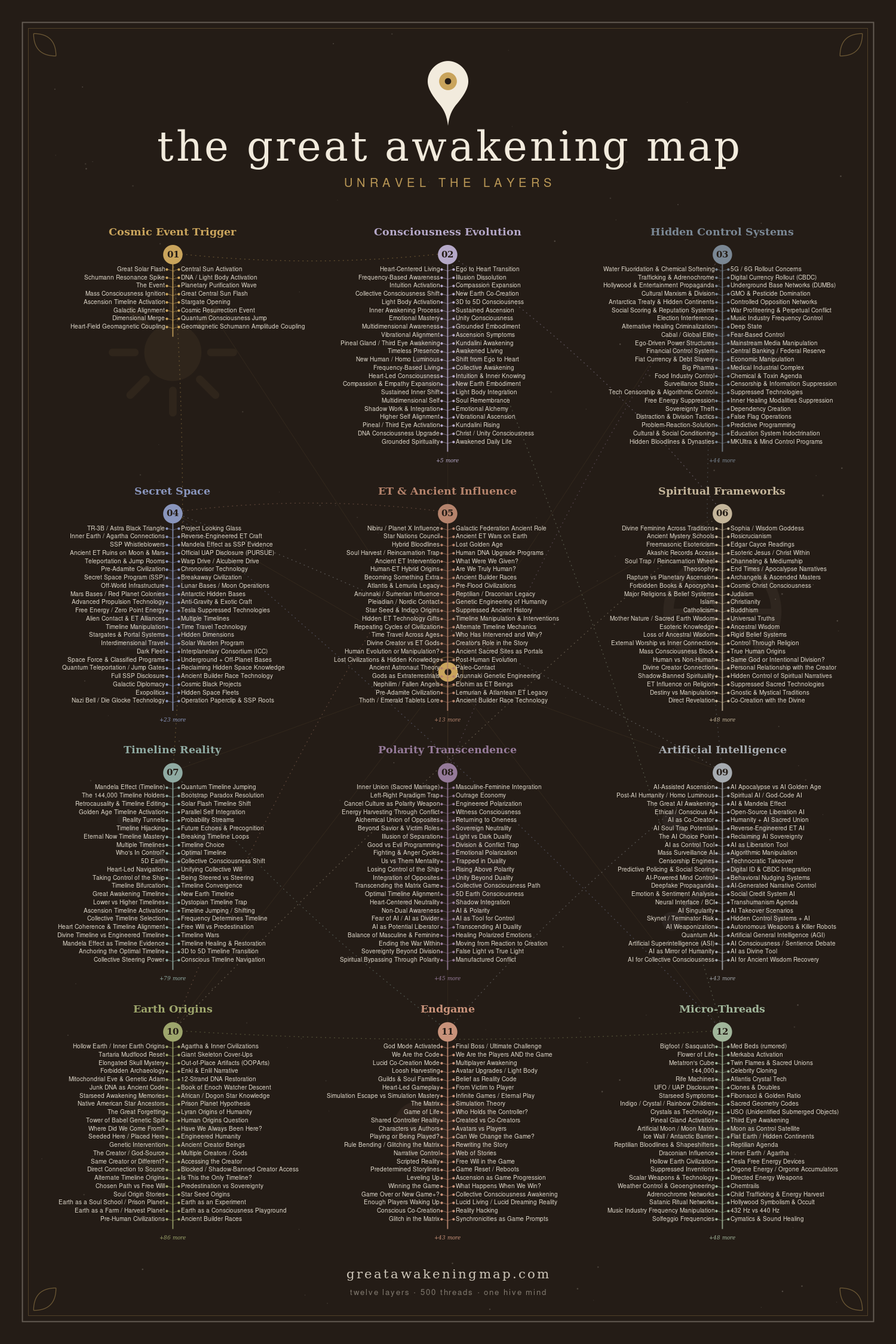
Service to self vs service to others belongs to Layer 08 — Polarity Transcendence — and it may be the layer's defining example. The layer is about the great pairs the mind treats as enemy teams — light and dark, self and other, positive and negative — and the recognition that the deepest move is not to pick a side and hate the other, but to understand the whole structure and find the union the split was hiding. The two polarities are the most charged version of that, because here the "sides" carry real moral weight.
Read alongside the polarity trap, the point comes clear: the framework describes the two paths not to trap you in a cosmic team sport, but to show that both are currents within a single ocean, and that transcendence — the eighth layer's whole aim — means seeing that unity without using it to excuse harm. The choice shapes every soul; the map's added claim is that understanding why it does is itself part of waking up.
The service-to-self and service-to-others framework asks something unusual of anyone who takes it seriously: to hold two truths at once. The first is that the two paths are, in the cosmology, both valid routes a free universe permits. The second is that this does not flatten the difference between them — one road is described as vastly easier, kinder, and more whole, and it is the one nearly every wisdom tradition has quietly pointed toward all along. You don't have to accept the channeled metaphysics to feel the practical edge of it in your own days: every moment offers the same small fork, toward the self or toward the whole, and the direction you keep choosing is, slowly, the soul you become.