
The symptoms of a spiritual awakening are confusing precisely because they don't announce themselves as spiritual. They arrive as tiredness, mood swings, ringing ears, broken sleep, and a creeping sense that the life you built no longer fits — the kind of thing you'd normally take to a doctor before you'd ever call it awakening. That's the honest starting point of this piece: an awakening is a real shift in how consciousness organizes itself, and it produces real, felt effects in the body and mind. The task isn't to romanticize every ache as cosmic, but to learn the actual signature so you can recognize what's happening, rule out what needs ruling out, and move through it with less fear.
What a spiritual awakening actually is
Before the symptoms make sense, the thing itself needs a plain definition. A spiritual awakening is a shift in your center of gravity — from living almost entirely inside the small, defended, story-telling self toward a wider awareness that can hold that self without being run by it. Old identities, beliefs, and coping patterns start to loosen. The version of you that was optimized for a smaller life begins to come apart so a larger one can form. That restructuring is not tidy, and the discomfort people call "symptoms" is largely the friction of the old scaffolding coming down while the new one is still going up.
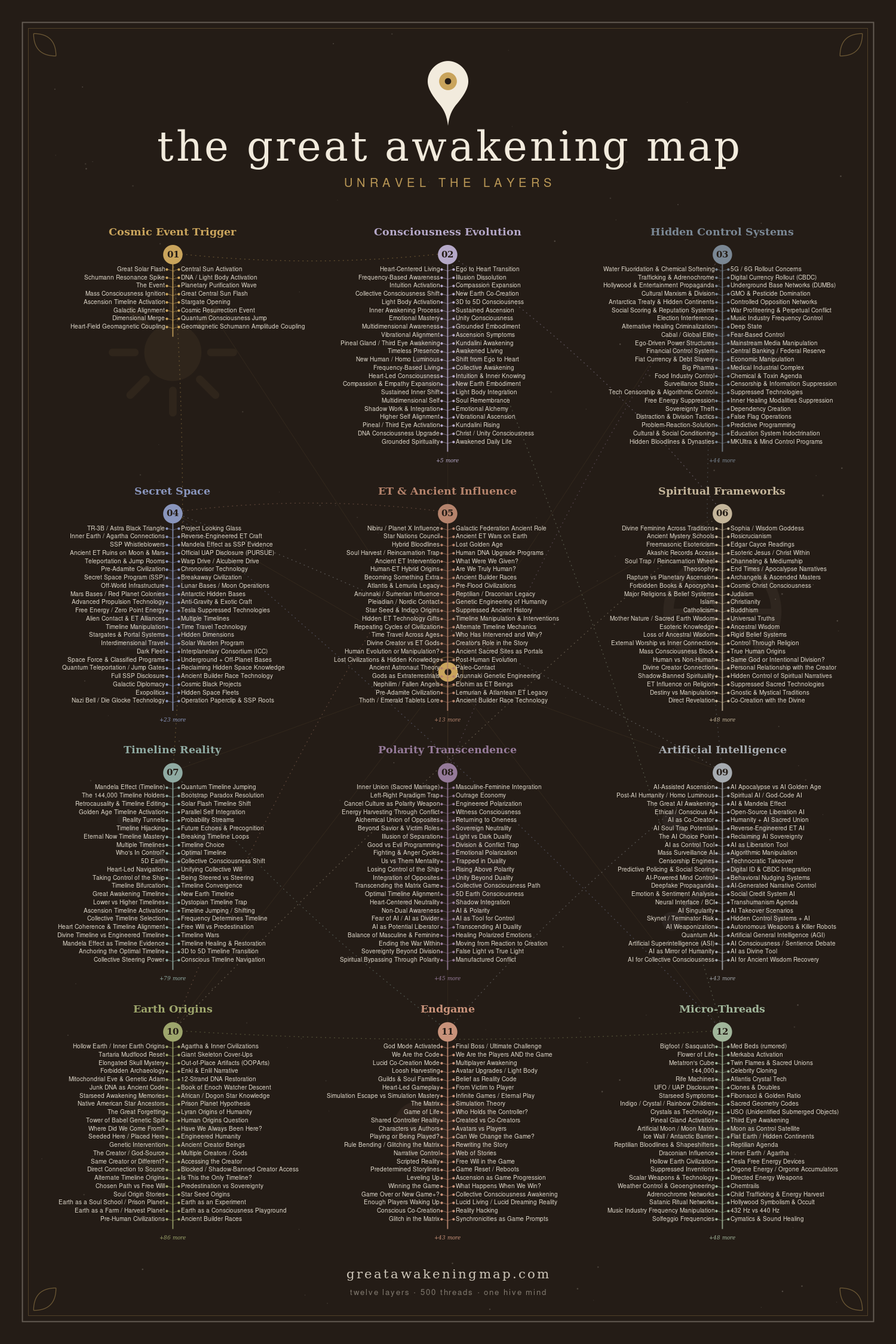
This is why the experience shows up across so many traditions under different names — the dark night of the soul, ego dissolution, ascension, kundalini rising. They describe overlapping territory: a deep reorganization of the self that feels, from the inside, like both loss and expansion at once. It sits at the heart of Layer 02 — Consciousness Evolution, the claim that consciousness isn't fixed but can genuinely change levels.
Physical symptoms of a spiritual awakening
The physical symptoms of a spiritual awakening catch people most off guard, because we don't expect an inner shift to land in the body. But the body is where a lot of it registers. Commonly reported spiritual awakening physical symptoms include:
Deep fatigue and waves of low energy, often out of proportion to how much you've done — a tiredness that sleep doesn't fully touch, as if the system is running a large background process.
Disrupted sleep, especially waking around 3–4 a.m., vivid or intense dreams, and stretches of insomnia followed by stretches of needing far more rest than usual.
Ringing in the ears, pressure or tingling around the head and forehead, and sensations of heat or energy moving up the spine — the cluster many map to the crown and third eye opening.
Changes in appetite and digestion, and sudden aversions to foods, alcohol, or substances the body used to tolerate, as if the whole system has recalibrated what it will accept.
Heightened sensitivity to light, sound, crowds, screens, and certain people — a thinner-skinned quality where overstimulation becomes genuinely hard to bear.
Aches, flu-like waves, and a racing or fluttering heart with no clear medical cause, often coming and going in episodes rather than staying constant.
A necessary, non-negotiable note: every one of these overlaps with real medical conditions — thyroid issues, anemia, sleep disorders, anxiety, cardiac problems. An awakening framing is never a reason to skip a check-up. The mature move is both: get the physical causes ruled out by a professional and hold the possibility that what's left is part of a shift. The body-literacy side of this — nervous-system regulation, nutrition, rest — is worth taking seriously, and Jennifer's sister site The Healing Almanac is built for exactly that grounded, physical layer of the work.
Emotional symptoms of a spiritual awakening
Emotionally, an awakening tends to turn the volume up before it turns anything down. Feelings that were long suppressed come loose, and they don't always arrive politely. People report:
Waves of unexplained emotion — crying without a clear trigger, sudden grief, or unexpected joy — as buried material surfaces to be felt and released.
Heightened empathy and porousness, feeling other people's states so strongly it's hard to tell where you end and they begin.
Restlessness and dissatisfaction with work, relationships, and routines that used to feel fine — a persistent "this isn't it" that logic can't talk you out of.
Anxiety, disorientation, or a dark-night heaviness, a stretch where the old meaning has dissolved and the new one hasn't arrived, which can feel bleak even though it's often the turning point.
A powerful pull toward solitude, and less tolerance for small talk, drama, and social performance that now feels hollow.
Here again the honest caveat matters: heavy, persistent low mood, hopelessness, or thoughts of self-harm are not something to spiritualize and wait out. They deserve real care from a real professional. "Awakening" and "depression" aren't rival explanations competing for the same person — they can occupy overlapping ground, and getting proper support is wisdom, not a failure of the path.
Energetic and mental symptoms
The subtler signs are harder to name but just as consistent. Many describe a shift in perception itself: colors seeming more vivid, a heightened noticing of synchronicities and repeating numbers, and a sense of time behaving strangely — days blurring, or moments stretching. Intuition sharpens; you "just know" things more often. There's frequently a strong new sensitivity to the states of places and people, and a felt response to nature, music, and silence that borders on overwhelming.
Mentally, old beliefs stop holding. Questions about meaning, death, reality, and purpose move from abstract to urgent. Some people describe a temporary brain-fog or difficulty concentrating on ordinary tasks, as if the mind's attention has been reassigned to a bigger reorganization happening underneath. None of this is a sign something is wrong with you — it's the cognitive weather of a system rebuilding its model of the world.
Kundalini and ascension: two intense versions
Two subsets of the awakening deserve their own mention because their symptoms run hotter. Spiritual awakening symptoms of the kundalini variety center on energy: heat, surging or electrical sensations moving up the spine, spontaneous shaking, pressure at the base of the skull, and intense states that can tip into overwhelm if they come on fast. When the process is gradual it can feel like blossoming; when it's abrupt it can be genuinely destabilizing, which is why the kundalini awakening guide emphasizes grounding and pacing over forcing.
Ascension spiritual awakening symptoms is the framing the awakening community uses for the same territory seen through the lens of density shifting — the body allegedly "upgrading" to hold a finer state. The reported signs overlap heavily with everything above: fatigue, ringing ears, emotional purging, heightened sensitivity. If you want that specific vocabulary and the twelve-sign checklist, it's laid out in the ascension symptoms and 5D shift piece.
How to tell an awakening from a health issue
This is the question underneath all the others, and the honest answer is: you don't decide between them — you hold both and let time and testing sort it out. A few rules of thumb help. First, rule out the physical. Persistent fatigue, heart symptoms, and sleep disruption warrant a doctor before they warrant a mystical reading; an awakening interpretation never overrides medical care. Second, watch the pattern. Awakening symptoms tend to come in waves that track with inner shifts — a hard week of purging followed by unusual clarity and lightness — rather than a flat, grinding constancy. Third, notice the meaning. Awakenings, however uncomfortable, usually carry a thread of expansion, insight, or rightness alongside the difficulty. If there's only heaviness with no opening, that leans toward something that needs treatment, not interpretation.
How to move through it
The practices that steady people through an awakening are unglamorous on purpose. Ground the body: rest without guilt, drink water, eat simply, get sunlight and time on the earth, and move gently. The nervous system is doing heavy lifting and deserves support, not more stimulation. Reduce the noise: less scrolling, less alcohol, less overstimulation — a finer system tolerates less static, and much of the suffering eases when the inputs drop. Let the emotions move: feel them, name them, journal them, cry them out; the symptoms intensify when the material is resisted and soften when it's allowed. Don't isolate completely: a trusted friend, a therapist, or a community that gets it keeps the solitude from tipping into something darker. And reconnect to the quiet center underneath the turbulence — the practice at the heart of finding your higher self, which is often what the whole disorienting process is clearing the way toward.
How this fits the awakening map
The symptoms of a spiritual awakening are the felt, personal edge of Consciousness Evolution — Layer 02 of the map. The layer's larger claim is that consciousness can shift levels, both individually and collectively; the symptoms are what that claim feels like from the inside of a single nervous system going through it. Read alongside ego death, kundalini awakening, and the 5D shift, this piece is the ground-level view: not the theory of the change, but the tired, tearful, tingling experience of actually being in it.
If your own list of symptoms sent you here half-worried something was wrong, hold two things at once. Take the physical seriously — get checked, rest, care for the body that's carrying all this. And consider that the disorientation might not be malfunction but reorganization: the old structure coming down because something roomier is being built. Awakenings are uncomfortable the way growth is uncomfortable. The discomfort isn't a sign you've gone off course — often it's the clearest sign you're finally on it.