Who made weed illegal is one of those questions with a satisfying answer and a true answer, and they are not the same answer. The satisfying one — the version that circulates in awakening circles, on podcasts, in documentaries — is that a newspaper baron and a chemical company conspired to kill hemp because it threatened their paper and fiber empires. The true one involves a Treasury bureaucrat whose agency had just lost its purpose, a press that discovered marijuana sold papers, a country primed to believe terrible things about Mexican immigrants and Black musicians, and a bill that passed while the American Medical Association was still objecting to it. This piece walks the documented record, tests the Hearst–DuPont hemp-paper story against it, and says plainly which parts hold.
Before 1937, cannabis was in the medicine cabinet
It is easy to forget how ordinary cannabis once was in American medicine. It entered the United States Pharmacopeia in 1850 and stayed there until 1942. Tinctures and fluid extracts were manufactured by the largest drug houses in the country — Eli Lilly, Parke-Davis, Squibb — and prescribed for pain, insomnia, migraine, and menstrual cramps. A physician in 1900 would have reached for it without a second thought.
He also would not have called it marijuana. In English-language medicine the substance was cannabis, and the word “marihuana” was not in official dictionaries before 1937. That detail matters more than it looks, and we will come back to it.
The first restrictions were also earlier and more local than the conspiracy version allows. Massachusetts banned cannabis in 1911. Mexico banned it nationally in 1920. Whatever happened in Washington in the 1930s, it did not start the process — it federalized one already well underway, driven largely at the state level by the same anxieties that would later go national.
Harry Anslinger and a bureau that needed a mission
The Federal Bureau of Narcotics was created on June 14, 1930, inside the Treasury Department. Treasury Secretary Andrew Mellon appointed Harry J. Anslinger as its first commissioner, a job he would hold for thirty-two years.
Anslinger’s wife, Martha Kind Denniston, was connected to the Mellon family — Andrew Mellon was her uncle by marriage. This is the thread the conspiracy account pulls hardest on, and it is real. But the historian John McWilliams, who wrote the standard biography, described the family link as “probable but not ironclad” as an explanation for the appointment, noting that Mellon had an obvious independent motive: the Prohibition bureau was riddled with corruption and Anslinger had a reputation as a clean administrator.
Here is the part most retellings skip entirely. For his first four years in office, Anslinger resisted federal action on cannabis. He treated it as a regional problem for states and localities, and argued his Bureau lacked jurisdiction. He was not lying in wait for hemp. He was ignoring it.
What changed was not a memo from a chemical company. It was December 5, 1933 — the repeal of alcohol Prohibition. The federal government suddenly had a large enforcement apparatus, a Depression-era appropriations fight, and nothing left to enforce. Within roughly two years Anslinger reversed his position completely. He began compiling the “Gore Files,” a collection of lurid violent-crime cases attributed to marijuana use, and cultivating reporters who would run Bureau-supplied stories under their own bylines.
The Hearst papers and the invention of “marihuana”
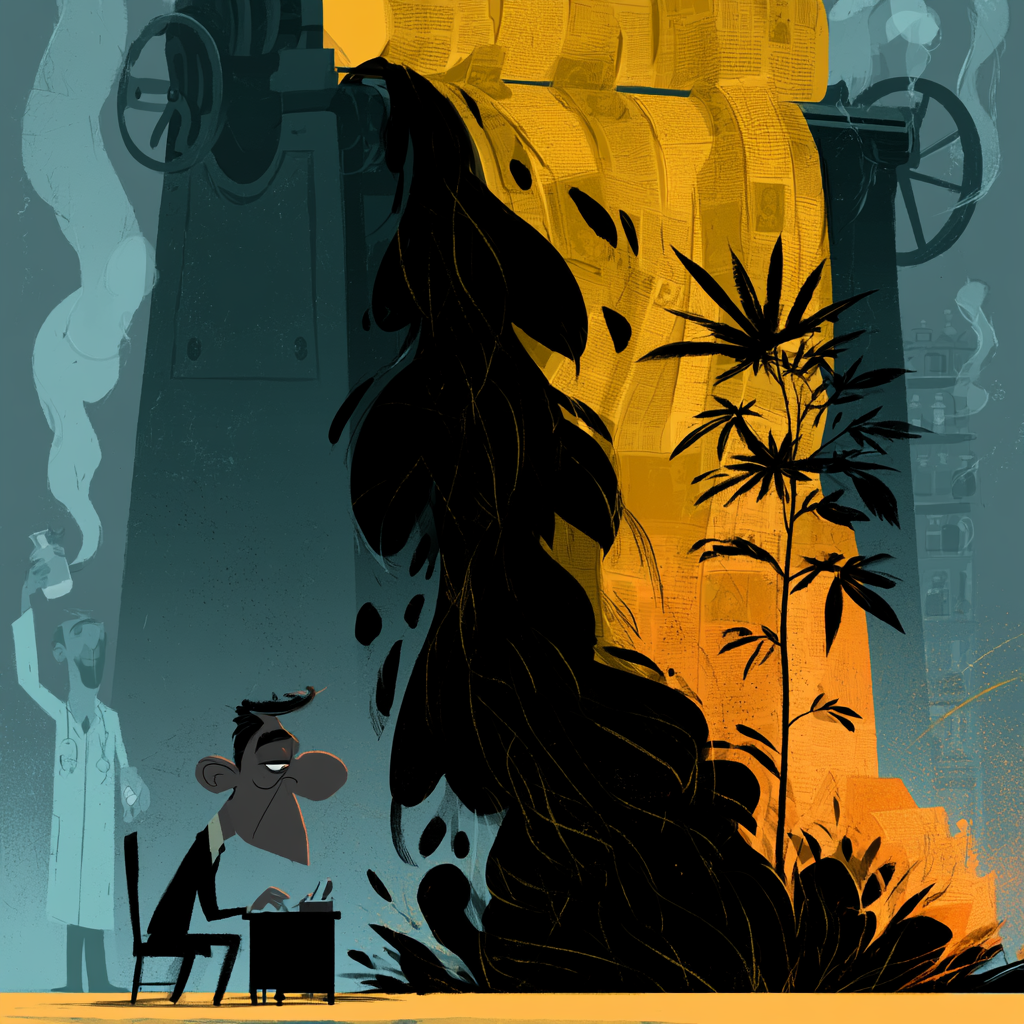
The press did its part enthusiastically, and the Hearst chain did it loudest. A January 5, 1933 headline — “Murder Weed Found Up and Down Coast” — is representative of hundreds like it. The stories were sensational, unsourced, and enormously effective. This is the piece of the conspiracy account that is not in dispute at all: Hearst newspapers ran a sustained, inflammatory, racialized campaign against cannabis, and it worked.
The naming did quiet work alongside the loud kind. Choosing the Spanish-derived “marihuana” over the medical term “cannabis” accomplished two things at once. It made the drug sound foreign, which fed the campaign’s central emotional appeal. And it obscured, from the doctors and pharmacists best positioned to object, the fact that the substance being demonized was already sitting in their own pharmacopeia. By one account of the legislative history, the Bureau “ensured that the medical profession did not recognize the threat to their pharmacopoeia until the bill was in hearings.”
The racial content is documented rather than inferred. Anslinger’s public rhetoric repeatedly tied cannabis to Mexican laborers and to Black jazz musicians, and a Bureau memo dated December 4, 1934, held at the Franklin D. Roosevelt Presidential Library, contains his use of a racial slur. It is worth adding a note of care here: several of the most quotable Anslinger lines that circulate online have thin or untraceable sourcing, and it is better to cite the memo and the testimony than the meme. The framing itself is not in doubt. The specific wording of every viral quote sometimes is.
The 1936 film Reefer Madness — released originally as Tell Your Children — belongs to this same climate, though it was a church-financed morality picture rather than a Bureau production.
The hemp paper theory: what Jack Herer actually claimed
In 1985 the activist Jack Herer published The Emperor Wears No Clothes, and it has shaped how a generation understands prohibition. Herer’s thesis names four figures: William Randolph Hearst, whose timber holdings supplied paper; DuPont, which had just patented nylon and new wood-pulp processes; Andrew Mellon, Treasury Secretary and, Herer said, DuPont’s banker; and Anslinger, the instrument who married into the Mellon family.
The motive, in this telling, was a machine. A hemp decorticator was about to make hemp cheap to process at scale, threatening both wood-pulp paper and synthetic fiber. A February 1938 Popular Mechanics article titled “New Billion-Dollar Crop” is the usual exhibit. Ban the plant, the argument goes, and you kill the competition before it starts.
It is a genuinely compelling story. It supplies a motive, it explains the timing, and it matches a pattern that anyone reading this map has learned to expect from the twentieth century. That is exactly why it deserves a hard look rather than a nod.
What holds up — and what doesn’t
Start with what survives scrutiny, because a fair amount does. The Hearst press campaign was real and inflammatory. The naming choice really did obscure the drug’s medical identity. Anslinger’s pivot really did follow the collapse of alcohol Prohibition and the Bureau’s need for a mission. And the Tax Act’s compliance burden really did shut down commercial hemp cultivation in the United States, whether or not that was anyone’s intent. Herer was pointing at real phenomena.
Now the load-bearing claims, which do not survive.
The chronology runs backwards. The Popular Mechanics article appeared in February 1938. The Marihuana Tax Act was signed on August 2, 1937 — roughly six months earlier. Defenders correctly note that magazines are typeset well in advance, but even granting that, an article cannot be the warning that triggered a law already on the books.
Hearst’s economics point the wrong way. He was the largest purchaser of newsprint in the United States, not a supplier of it. Cheaper hemp-based paper would have cut his single largest input cost. The conspiracy asks us to believe he spent years campaigning to protect a price he was paying.
The decorticator never arrived. George Schlichten patented his hemp decorticator in 1917. It was never commercially deployed at scale, and Schlichten died in 1923 without achieving industrial production. The machine that supposedly panicked an industry was, in 1937, a lapsed patent and a dead inventor.
Nylon was not competing with hemp. DuPont’s new fiber was aimed at silk and rayon — stockings, not rope — and the company said so at the time.
The Mellon–DuPont banking link is undocumented. Researchers who went looking through interlocking corporate directorates found no documentary evidence supporting the specific relationship as Herer described it.
And the timing problem cuts from the other direction too. Massachusetts banned cannabis in 1911; Mexico banned it in 1920. Those predate any possible coordination among Herer’s four conspirators. As one survey of the historiography puts it, the Herer thesis “is not treated as a serious explanation for prohibition by any major academic historian of drug policy.”
So why is weed illegal? What historians actually say
The academic account attributes federal prohibition to four braided causes: racialized moral panic, bureaucratic empire-building, sincere if badly-informed public-health concern, and the organizing energy of Protestant reform networks that had just won on alcohol and were looking for the next campaign.
It is worth sitting with the fact that this is not the gentler version. A conspiracy is almost comforting: it implies a small number of identifiable bad actors, and it implies that without them the thing would not have happened. What the record actually shows is that a widely used medicine was moved from the pharmacy to the prison without a conspiracy — because an agency needed a budget, a newspaper chain needed circulation, and a public was willing to believe nearly anything about people it already feared. No secret meeting was required. That is the harder finding, and the more useful one.
How the Marihuana Tax Act of 1937 actually passed
Representative Robert L. Doughton of North Carolina introduced the bill as H.R. 6385 on April 14, 1937; it was later redrafted as H.R. 6906. The text was drafted inside Anslinger’s Bureau. Hearings ran five days — April 27, 28, 29, and 30, and May 4, 1937.
The most-cited moment in those hearings is the testimony of Dr. William Creighton Woodward, legislative counsel for the American Medical Association, who opposed the bill. Woodward told the committee that the claims about marijuana addiction, violence, and overdose were not supported by evidence, and warned that the law would obstruct legitimate medical research. The AMA’s alternative proposal was to fold cannabis into the existing Harrison Narcotics Act rather than build a new tax regime around it. The committee was not receptive. The bill moved anyway.
Roosevelt signed it on August 2, 1937, effective October 1. Technically it was never a ban — it was a tax-and-registration scheme, with a nominal per-ounce levy on registered handlers and a punitive structure for everyone else, plus paperwork requirements that made lawful handling close to impossible. The design was borrowed; it was the same mechanism already used against other drugs, and it worked precisely because a law that merely taxes is harder to challenge than a law that forbids.
Enforcement was immediate. Within days of the Act taking effect, Samuel Caldwell and Moses Baca became the first people federally convicted under it. Judge John Foster Symes sentenced Caldwell to four years at Leavenworth and Baca to eighteen months.
From tax stamp to Schedule I
The Tax Act held for thirty-two years and then broke on its own logic. In Leary v. United States (1969) — brought by Timothy Leary — the Supreme Court struck down part of the Act on Fifth Amendment grounds: obtaining the required tax stamp forced a person to incriminate himself.
Congress responded the next year. The Controlled Substances Act of 1970 repealed the Tax Act and placed marijuana in Schedule I, the most restrictive category, defined as substances with high abuse potential and no accepted medical use. That placement was explicitly meant to be provisional, pending the findings of a commission.
The commission reported on March 22, 1972. Chaired by former Pennsylvania governor Raymond P. Shafer — a Republican and Nixon’s own appointee — its report, Marihuana: A Signal of Misunderstanding, recommended decriminalizing possession and treating use as a social rather than criminal matter. Nixon had already announced how he would receive it: “Even if the commission does recommend that it be legalized, I will not follow that recommendation.” He did not. Schedule I stayed put for the next fifty-four years.
One more piece of this era deserves care, because it is quoted constantly. In April 2016 the journalist Dan Baum published an essay in Harper’s containing a remark he attributed to Nixon aide John Ehrlichman from a 1994 interview: that the administration had two enemies, “the antiwar left and Black people,” and that by associating hippies with marijuana and Black Americans with heroin and criminalizing both heavily, “we could disrupt those communities.” The quote is devastating and it is also disputed — no recording has been released, Ehrlichman’s children rejected it publicly, and drug-policy historians including Emily Dufton and Isaac Campos have argued it is too tidy to take at face value. The honest position is to know both halves: that the quote exists and that its provenance is contested. The documented disparate impact of the drug war does not rest on it.
Where things stand in 2026
As of April 2026, 24 states and Washington, D.C. have legalized recreational marijuana and 40 states plus D.C. allow medical use. Eight additional states permit CBD-only products. Two — Idaho and Kansas — maintain full prohibition.
Federally, the wall has begun to move. On April 23, 2026, the Justice Department and DEA placed FDA-approved marijuana drug products and medical marijuana sold under a qualifying state license into Schedule III, acting under an executive order signed December 18, 2025. Marijuana as a general matter remains Schedule I; an expedited administrative hearing on the broader Schedule I to Schedule III move opened June 29, 2026.
Read that against 1937 and the symmetry is hard to miss. Eighty-nine years after Dr. Woodward told a congressional committee that the medical claims against cannabis were unsupported, the federal government has started formally conceding the specific point he was making — that there is such a thing as accepted medical use.
How this fits the awakening map
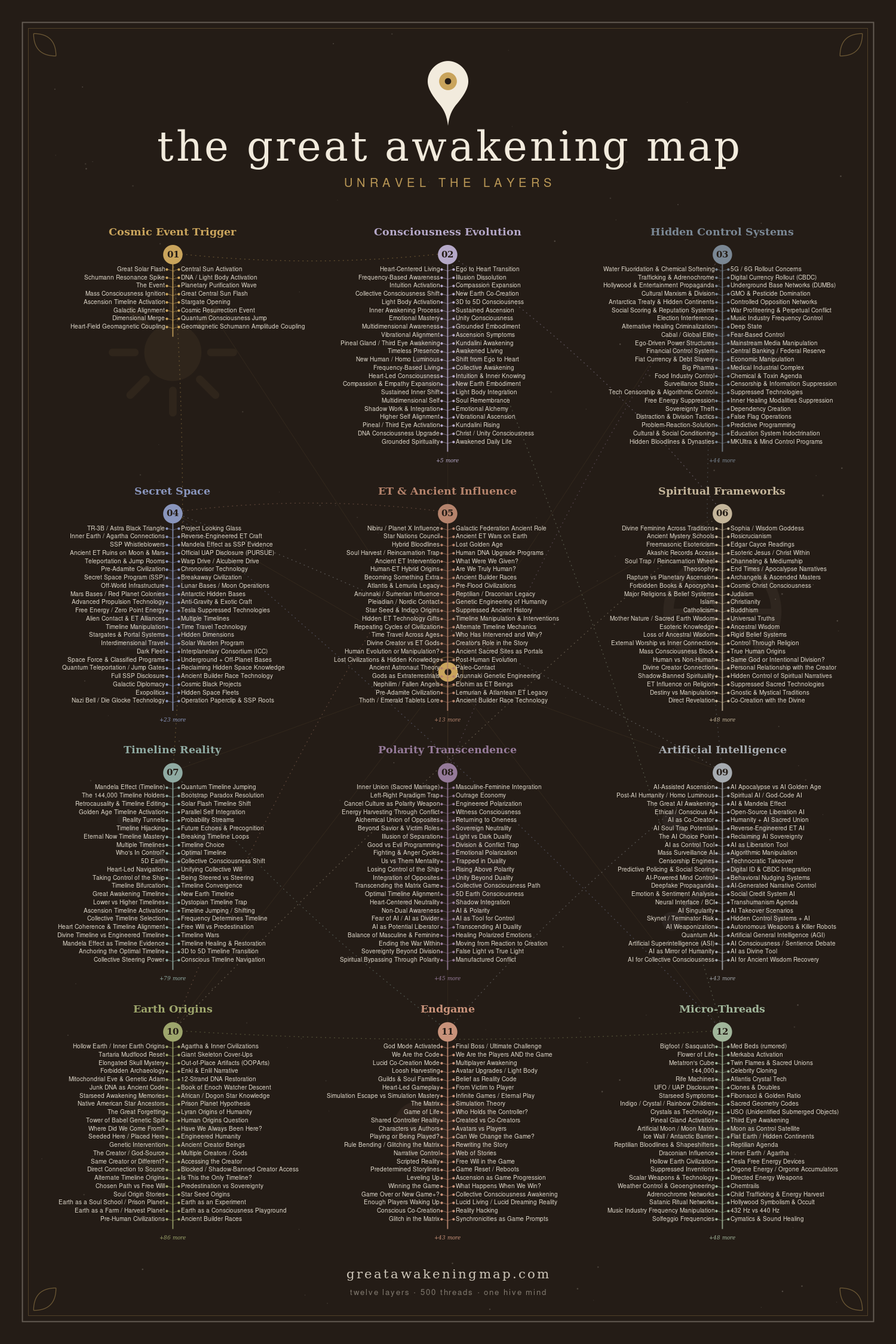
Cannabis prohibition sits in Layer 03 — Hidden Control Systems — and it is close to a laboratory specimen for what that layer studies. The mechanism on display is not a smoke-filled room. It is narrative arriving before law, and evidence never really being invited into the room at all. The Bureau supplied the stories; the papers ran them; the hearings lasted five days; the one expert body that showed up with data was brushed aside; and the resulting statute outlived every person involved in writing it.
That pattern recurs across the layer. It is the same shape as mainstream media manipulation, as the medical-industrial complex thread, and especially as the suppression of inner healing modalities — a plant with a long therapeutic record removed from the pharmacopeia and relocated to the criminal code, then held there for most of a century by institutional inertia rather than by any finding. If you are interested in the plant’s traditional and therapeutic side rather than its legal history, our sibling site The Healing Almanac is where that thread lives. For why it is still illegal — the alcohol and pharma lobby question, and what Texas banned in 2026 — see the companion piece. For the broader machinery, see the deep state explained.
There is a discipline point here too, and it is aimed at us. The hemp-paper version of this story has been repeated inside the awakening community for forty years, including by people who are right about a great deal else. Holding this map honestly means being willing to drop the version that flatters the frame when the record does not support it. The documented account is more damning, not less — and a claim you can defend in front of a skeptic is worth more than ten you cannot.
So: who made weed illegal? A bureau that needed a reason to exist, a press that found a profitable villain, a Congress that gave it five days, and a public that had already decided who it was afraid of. No cabal necessary. The hemp-paper story survives because it offers a cleaner villain than the real one, and the real one is uncomfortable precisely because it did not require anybody to be especially evil — only for enough people to find it convenient. That is the thread worth pulling, and it does not end in 1937.